
Glossary
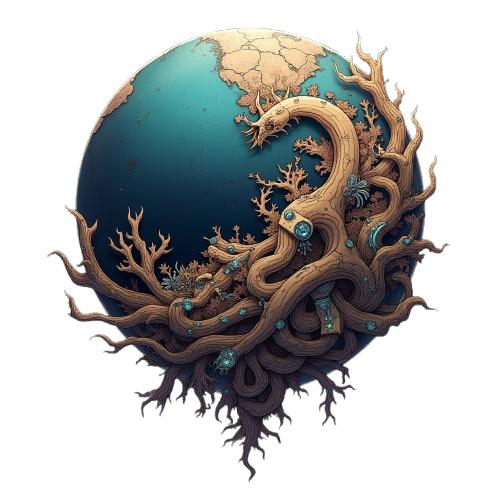
A guide to the terms, creatures, and customs of the living world of the Mother. Entries cover everything you need to find your bearings inside the Sac. Tags mark terms that appear in a specific story; untagged terms belong to the shared fabric of the world.
A
Aeration Membrane ART
A suspended reactive membrane that, through specialised bacterial colonies, responds to sound by changing shape, creating currents of fresh air and purifying the atmosphere — especially valued during Stagnation. The system relies on acoustic resonance and bacterial symbiosis, with opposing fans working in synchrony, attracting and repelling each other in cycles. First installed in public spaces, later adapted for noble private quarters.
Akhenasi
A sacred and binding pact founded on the principle of disproportionate debt. When someone receives help in a moment of desperate need, they incur an obligation to return a far greater favour in the future, with no time limit. Refusing to honour an Akhenasi is considered the worst infamy. The pact is sealed by pronouncing the ritual words "I accept the Akhenasi," followed by "An Akhenasi has been bound." Whoever enters it is bound to the other until the debt is fulfilled.
Antibody ART
A predatory creature of the Mother's immune system. In the noble tower they are used to defend the most frequented areas, such as exits.
Architects
Members of a Profession that manipulates the organic growth of living structures. Through glandular stimulation, the introduction of specific compounds, and tissue grafting, they cultivate buildings rather than build them, inducing membranes and tissues to calcify, extend, or develop into functional forms. They are recognisable by their tattooed foreheads, and they program the routes of worms using glyphs incised directly into the animals' skin. Like other Professions, they hold their own tower in the city.
Artists ART
Members of a Profession that has been in decline for centuries but is still practised unofficially. Artists manipulate living pigments, reactive membranes, and bacterial colonies to create works that change, respond, and evolve. They are recognised by ritual scars on their cheeks: one line for initiates, two for qualified apprentices, three for masters. These scars are often painted with living pigments that shift colour in response to emotion or environment. Despite official persecution, artists guard the secrets of their Profession jealously, passing them from master to disciple.
Axe, Southern GAT
A specialised gathering tool with its weight distributed along the entire length of its horn shaft, unlike a regular axe. Designed not only to cut polyp-tree stalks but also for self-defence against tentacles and other dangers of the Black Heart.
B
Bagpipe GAT
A living musical instrument that requires careful feeding and maintenance. It can become "constipated" if fed too much resin, producing strangled sounds until cleared.
Bioclast GAT
A creature found within the Sac, sometimes encountered dead in necrotic pools.
Bioscope HEA
An analysis instrument used by healers to examine biological samples, composed of observational membranes that can be adjusted to magnify and study detail.
Black Heart GAT
A vast forest of polyp-trees surrounding the Southern Greater and covering much of its height. Extremely dangerous due to tentacles, stringers, and other hazards.
Bluebark
A precious textile material derived from the Mother's internal membranes, treated with techniques known only to nobles. Its deep indigo-blue base is interwoven with iridescent filaments that catch and chase the light as the wearer moves — soft to the touch yet durable. The most exclusive of fabrics: a status symbol whose quality and pattern instantly mark a noble's rank. Bluebark is forbidden to anyone outside the nobility, on pain of Selection.
C
Cartographers
Members of a Profession that studies, documents, and predicts changes in the membranes of the Sac, surveying polyp-tree growth to contain the Black Heart's expansion. They are recognisable by their white-and-grey clothing and by the crest running down the centre of their shaved heads — the higher and longer the crest, the greater their rank. They use specialised tools such as the chromograph and their own system of glyphs.
Chromatic Peat ART
A living organic substrate used by artists, formed by a complex symbiotic colony of bacteria, moulds, and microorganisms. Held in pulsing sacs, the peat visibly breathes and trembles at a touch. Artists work it by introducing chemical precursors or emitting sounds at calibrated frequencies, inducing the production of different pigments. Each colony has a unique "personality," with chromatic tendencies the artist must learn to know and respect.
Chromograph ART
A sophisticated instrument used by cartographers, composed of sensitive crystals set in a structure of calcified cartilage, used to detect variations in the density, permeability, and composition of membranes.
Circles HEA
The internal hierarchy of the healer Profession. From the First Circle (novices) to the Fourth Circle (masters), it organises healers by competence and seniority. The Fourth Circle forms the Profession's decision-making council and holds its most secret knowledge.
Commoners
The most numerous and subordinate class of the Sac — all those who belong neither to the nobility nor to a recognised Profession. They perform essential but unspecialised work: gathering food, maintaining structures, producing necessities. They live in modest dwellings in the outer districts on limited rations, and have little voice in the decisions of society. They are subject to Selection at the age of forty. Some commoners have their earlobes cut away as punishment for crimes, marking their degraded status.
Crimson Nails HEA
The distinctive mark of healers: nails pigmented red through symbiosis with organic receptors. Extremely hard and sharp, they take three years of pain to develop fully.
D
Dermaloid HEA
A large red-violet organism used for surgical training, with a consistency identical to human skin. It is equipped with defence mechanisms that can make it dangerous if handled improperly.
E
Earlobes
Social markers of status across the Sac. Nobles bear elaborately pierced lobes; Profession members keep intact lobes painted in colours that signal their rank; commoners who commit crimes have their lobes progressively cut away. (See also: Pierced Lobes.)
Elevation
An exceptionally rare ceremonial process by which a meritorious member of a Profession can be raised to noble rank. It involves a series of secret rituals culminating in the ceremonial piercing of the earlobes, the symbol of new status. Elevation grants exemption from Selection and substantial privileges, but is bestowed only once or twice a generation — and, being often the object of political intrigue, can be revoked only by the noble chief in person.
Extractor HEA GAT
A medical instrument composed of a translucent needle connected to a pulsing vesicle, used to draw blood or other bodily fluids. It has two modes of use, one in which the needle rotates. It causes intense pain in use — especially when the needle is inflamed — but is highly effective.
F
Fluid Sphere ART
A spherical organic container used to store and consume liquids, formed by a semi-transparent elastic membrane that holds its integrity until the upper orifice is opened, after which the contents can be sucked out. Specialised variants exist for different fluids: those for winefluid are particularly resistant, to prevent the alcoholic substance from spilling. (See also: Sphere.)
Fortune GAT
A deity or concept venerated alongside the Mother, associated with luck and chance. Commoners often invoke Fortune in their oaths and prayers.
Fungmoth GAT
A small parasitic creature with a spongy body that lands on exposed skin, its tiny mouth-filaments burrowing painfully into flesh. When crushed it leaves a damp, rotten-smelling pulp.
Fungus-chair
Living furniture that grows directly from the floor through controlled membrane stimulation. An organic base anchors it firmly to the ground while the upper surface moulds to the body, reacting to weight by adjusting its consistency for comfort. In finer dwellings, these can be "trained" to recognise their owner and assume their most comfortable shape automatically.
Fungus-table GAT
Living furniture that grows from the floor, used as a communal eating surface. It often drips with condensation from the ceilings above.
G
Gatherer GAT
A commoner who harvests food and resources and performs other manual labour. Gatherers work in squads led by a squad leader, with graybarkers providing protection from tentacles.
Glowstones
Bioluminescent formations embedded in the Vault of the Sac that regulate the illumination of the entire environment. Like organic gems set in living tissue, they emit a pulsing light that rises and falls in regular cycles, creating the alternation of day and night. They dim to a reddish glow at night and can be obscured by polyp-tree tentacles; during Stagnation their light grows dim and diffuse, adding to the period's sense of oppression.
Glyphs
A system of symbolic writing used by the various Professions to record specialised knowledge. Each Profession has developed its own glyph language, kept secret from outsiders and passed only to initiates; knowledge of another Profession's glyphs is regarded as suspicious, save among high-ranking nobles with free access to all knowledge. Common glyphs, by contrast, serve public communication and can be read by literate commoners.
Graft HEA
A medical procedure in which nutritive or therapeutic tissue is transplanted into a host organism. It demands great precision to avoid rejection.
Graybark GAT
A dark, clump-like substance that graybarkers chew to produce their characteristic sweet smell. Highly addictive and progressively destructive — it causes memory loss, emotional instability, and a shortened lifespan. The first dose produces intense pleasure, making addiction almost immediate; extended use leads to unpredictable violent episodes.
Graybarker GAT
A person who chews graybark, producing a sweet smell that repels polyp-tree tentacles — essential for a squad's protection in the Black Heart. Recognisable by their gray-stained lips. The substance brings progressive mental deterioration, memory loss, and eventual death.
Greater Analgesic Vesicle HEA
A medical organism used to relieve pain during invasive surgery; part of the healers' therapeutic arsenal.
Greater Membrane
A vast organic structure forming part of the Mother's primary anatomy and essential to the functioning of the Sac's ecosystem. Hundreds of metres tall, it filters the light of the glowstones and defines the boundaries of the known world. It is divided into geographic regions: the Southern, Western, Eastern, and Northern Greater.
Greenbark GAT
A valuable textile material derived from the Mother's membranes, semi-transparent and used for clothing. It ranks below bluebark and is commonly worn by members of the Professions; among commoners, only the most prosperous can afford to wear it, making it a status symbol.
Greenbread
A staple food of the Sac, a kind of bread made by fermenting spores cultivated on special substrates. Pale green, crisp outside and soft within, it carries all the nutrients essential for survival. Its production is controlled and rationed, distributed in quantities that vary by social rank; in times of shortage it is cut with less nutritious matter, keeping its appearance while losing its value. Among gatherers it is distributed as rations, and corrupt head gatherers sometimes adulterate it with resin to stretch supplies.
Guardians
Members of a Profession dedicated to keeping order and enforcing the laws. Easily recognised by their ritually sharpened teeth — more modified teeth indicate higher rank — and by glyphs inlaid on the teeth themselves. Trained in combat and the use of specialised weapons such as spine rifles, vesicular staffs, and knotty staffs, they patrol the city constantly and wear chest plates. Some are chosen to serve nobles directly in the tower. Feared by the population, they are extremely dangerous combatants.
Gut-noose GAT
A weapon of living tissue, activated by squeezing one end. Wrapped around a target and triggered, it constricts and expands, capable of strangling. It has a safety mechanism that must be released before use; some owners name their gut-nooses.
H
Hall of Pain HEA
A medical chamber used for "intensive teachings," where chemicals and instruments inflict controlled pain for educational purposes.
Head Gatherer GAT
A literate commoner who manages gatherer operations at a fort, assigning corvée shifts and keeping records. Recognisable by painted earlobes (green indicates rank). They have access to better food and housing but remain subject to Selection.
Healers HEA GAT
Members of a medical Profession marked by nails pigmented crimson with indelible colour. Experts in anatomy, medicine, surgery, and genetics, they treat diseases, wounds, and deformities through organic remedies, surgical work, and tissue manipulation. They are organised into four Circles and follow the Four Protocols as their fundamental principles, and they hold the authority to perform Selection on commoners.
Healing Membranes GAT
Translucent organic bandages that move frantically when near blood, then mould to a wound and fall still once properly applied.
Heatfungus ART GAT
An organism that generates constant heat through accelerated metabolic processes. Semi-spherical, with a swollen cap, it emits an orange-red glow when active. Its temperature can be regulated by stimulating specific points or feeding it different substrates — used for cooking, heating spaces, and activating chemical reactions in artists' pigments. During its stasis phase the surface turns opaque and the heat drops sharply until reactivation.
Horn Shaft GAT
A material used for tool handles, made from calcified organic matter, smooth and polished for gripping.
Horn Spear GAT
A weapon with a shaft of horn material and a sharp point, used for combat and hunting.
I
Ichor HEA GAT
A bodily fluid of various colours (purplish, bluish) that flows from wounded or decomposing organisms. It has corrosive properties and can be toxic.
L
Last Fort GAT
The southernmost gatherer settlement, near the Black Heart at the Southern Greater. Known as the harshest posting for its dangerous work, poor food, and proximity to the polyp forest — named because "it's the last place you'll ever see."
Lymph Node GAT
An organic growth used as food for worms, carried by attendants.
M
Membrane-blackboard HEA GAT
A living surface inscribed with a stiletto. In healer classrooms it possesses an orifice that, stimulated correctly, erases incisions by healing the wounds; in gatherer forts it sits in the courtyard, where daily work assignments are carved for all to read.
Membrane-window HEA GAT
A translucent, pulsing opening in a wall that serves as a window. It opens by inserting a finger into a side orifice and making specific movements, and can close again. It carries defensive mechanisms that make it lethal if deliberately damaged — capable of severing the fingers of an unauthorised user.
Memberblade HEA
A living surgical instrument that looks like a translucent organic blade. It can vibrate and change colour when annoyed — very sharp, but sensitive to heat and to inappropriate handling.
Membrid HEA
A sewer creature the size of a fist, with a translucent exoskeleton and thread-like legs. It can hibernate for decades and is extremely sensitive to certain chemical compounds, which kill it violently.
Mother
The enormous living organism within which all humans of the Sac exist. Considered a living deity, the Mother is perceived as a sentient being that houses, nourishes, and protects the population in exchange for human sacrifices (the Selection). Her internal structure — membranes, veins, glands, filtering systems, and other organic components — forms the whole of the human habitat, and she is the source of all organic structures and life within the Sac.
Mother's Mouth HEA GAT
A circular opening in a wall, surrounded by pulsing red fleshy folds, used to dispose of organic waste — including corpses. It reacts to the presence of organic matter by dilating and drawing it in with peristaltic movements. Criminals are sometimes Selected by being thrown alive into one.
N
Necrotic Tissue GAT
Dead or dying floor matter, black and glossy, that forms pools of fermenting liquid. Its removal is extremely dangerous because of the stringers that emerge from the pools.
Neurovegetative Polyp-fungus HEA
A medical organism used to treat paralysis of the lower limbs — one of many symbiotic organisms cultivated in the healers' greenhouse.
Noble Chief
Also known as the Lord of the Sac, the Noble Chief is the supreme authority, recognisable by earlobes divided into thin fringes that fall to the shoulders. The Noble Chief holds absolute power of life and death over all inhabitants and may change the laws at will. With rare exceptions, the position is hereditary.
Nobles
The highest social class, exempt from Selection and free to live until natural death. Recognisable by their elaborately pierced earlobes, whose number, arrangement, and complexity mark precise rank. (See also: Pierced Lobes.)
O
Overseer GAT
An armed commoner who keeps order among authorized structures. Overseers retain one or both earlobes (depending on their history) and carry spine rifles.
P
Petroclast
An extremely hard calcified organic material, like stone but of biological origin. Extracted from formations deep within the Sac, it can be cut and shaped while fresh, but once exposed to air it hardens until nearly indestructible. Shining grey, brown, black, or translucent, it is used for tools, weapons, and structural elements. Petroclast blades are among the deadliest weapons known, holding a keen edge for decades without sharpening.
Pierced Lobes
The distinctive and unmistakable sign of nobles: elaborate piercings and modifications of the ears whose number, arrangement, and complexity indicate precise rank in the noble hierarchy. The highest ranks bear lobes divided into thin strips, like fringes, so numerous they fall to the shoulders. The piercings are performed ritually in private ceremonies and are often adorned with inserts of iridescent membrane or worked calcified cartilage.
Pigment ART
A living colouring substance produced by specialised bacterial colonies. Unlike inert colours, the pigments used by artists are symbiotic organisms able to respond to external stimuli by shifting hue and intensity. They are cultivated in sacs of specific nutrients that shape their properties, and the most skilled artists can "teach" them particular chromatic configurations, creating works that change and evolve in response to environment or sound.
Polyp-tree GAT
Tall organic growths with stalks covered in tentacles that sway and grasp, found in the Black Heart forest. Stalks are harvested with three-point cuts; the trees pulse in unison and can "scream" when felled. Young polyps are easier to cut than older ones.
Professions
Specialised classes occupying the middle of the social hierarchy — above commoners but beneath nobles. Each Profession (cartographers, healers, guardians, architects) is marked by specific knowledge, traditions, and distinctive physical signs, and like the nobles each holds its own tower overlooking the city. For all these privileges, Profession members too are subject to Selection at forty. They live in dedicated districts organised around their towers. Over the centuries many Professions have decayed — a sign of society's inexorable decline — and some, such as the artists, continue to exist unofficially, opposed by the rest of the population.
Protocols, The Four HEA
The four fundamental principles that govern every aspect of a healer's life:
First Protocol — All for the Mother: the Mother holds absolute priority over every other consideration; the foundation of all medical knowledge and of society itself.
Second Protocol — All for humanity: humanity must prosper, but only in its purest and healthiest form. It justifies the merciful elimination of compromised births and malformations, and includes the principle that "a healthy mind dwells in a healthy body."
Third Protocol — All for knowledge: the preservation and transmission of medical knowledge — and its protection from those unworthy of it. Sharing such knowledge with non-healers is punishable by early Selection.
Fourth Protocol — All for mercy: the mercy required when no hope remains. The most enigmatic and contested of the Protocols, whose true meaning is revealed only to members of the Fourth Circle.
R
Resin GAT
A substance used to preserve organic materials and to clean items of fungmoths.
Ritual Orgies HEA
Mating ceremonies organised by nobles for procreation, alternating between noble men with women of the Professions and noble women with men of the Professions, to avoid incest.
S
Sac
The term the inhabitants use for their world: a biological pocket within the Mother's body. The Sac includes the main city, the peripheral areas, the Greater Membrane, and the sewer system beneath. Bounded above by the Vault and on every side by the Greater Membrane, it is a wholly enclosed environment with its own self-sufficient ecosystem, illumination cycles regulated by glowstones, and a circulation of fluids and gases. Its inhabitants have no awareness of anything existing outside it.
Selection
The sacrificial ritual in which people are offered to the Mother on reaching the established age — traditionally forty, for commoners and Profession members alike. Nobles are exempt and may live until natural death. Some offer themselves early, gripped by religious fervour or desperation; criminals may be Selected ahead of their time as punishment, methods varying — some dispatched quickly by healers, others thrown alive into a Mother's Mouth.
Sewers ART
A vast system of conduits, caverns, and levels extending beneath the entire Sac, inhabited by outcasts organised into bands under their own chiefs. The air hangs thick with acrid odours, the conduits are slick or furred with fungal growth, and light comes mostly from rare bioluminescent colonies.
Sphere
A spherical organic container for liquids, its elastic membrane opened to suck out the contents and crumpled flat when empty. Used for food, drinks, and medicines, and for storing fluids such as winefluid. (See also: Fluid Sphere.)
Spine Rifle GAT
A weapon that fires spiral spines with great force. It must be reloaded and has a safety mechanism; the rifle itself is organic and can become "annoyed" if mishandled, potentially firing on its own.
Stagnation
A cyclical period whose conditions vary by region of the Sac. In the central areas it brings stifling heat and humidity, with reduced air circulation and rising toxic exhalations; in the south, near the Black Heart, it instead brings extreme cold and heavy fog. Throughout, the membranes pulse more slowly, fluids move with difficulty, and the glowstones dim. The population suffers lethargy, irritability, and a rise in respiratory illness; conditions worsen as Stagnation ends.
Stilt-house GAT
An elevated dwelling built on support poles above the ground, reached by walkways and descent poles. Common housing in gatherer settlements.
Stiletto HEA
A thin, sharp petroclast instrument used for precise incisions on membranes and living tissue.
Stringer GAT
A dangerous creature that emerges from necrotic pools and from underground. It is composed of countless thread-like appendages, each tipped with a bulbous, triangular-pupiled eye, that weave together into a larger body with a tooth-filled mouth. Stringers hunt by sensing vibration and are drawn to blood — primarily nocturnal, but rousable by noise. They feed swiftly and violently.
Symbiotic Colony ART
A complex symbiotic organism used by artists, composed of anaerobic bacteria, pigment-bearing moulds, and regulatory microfauna in perfect balance. Symbiotic colonies react to acoustic, thermal, and chemical stimuli by altering their composition and releasing different pigments. Each has its own "vibrational signature" that the artist learns to recognise and manipulate, and once a colony "learns" a configuration it retains it in biological memory, to be recalled with the same stimuli.
T
Tendon Rifle GAT
A weapon that fires long, slimy projectiles capable of killing quickly. Used by cartographers.
Tentacles GAT
Appendages extending from polyp-trees, ranging from arm-thin to enormous. They sway and grasp at prey and can rise from the ground as tentacle-roots. They are repelled by the smell of graybark.
Three-point Cut GAT
The proper technique for harvesting polyp-tree stalks: three vertical cuts following the grain of the tissue to create triangular sections.
Tower
A building of several floors, reserved for the Professions and the nobles. Unlike common dwellings, which grow organically from the floor of the Sac, towers are complex structures requiring the coordinated work of many architects. Within some, living tissues are especially reactive and sensitive, with biological security systems that respond to intruders. The healers' tower is pyramidal, housing classrooms, laboratories, greenhouses, lodgings, and the library across multiple floors. The noble tower is the most imposing — six floors crowned by a conical dome that periodically releases clouds of luminous spores — the seat of political power and the residence of the noble chief and his family.
Trace GAT
A biometric signature registered with organic structures such as valve-doors and membrane-windows, allowing authorised users to open secured passages. It can be deleted or transferred by those with architectural knowledge.
Tubers HEA
Plant organisms cultivated as food, of various shapes and colours; part of the basic diet alongside other organic products.
V
Valve-door
An organic opening that serves as a door, formed of overlapping membranes that open and close in response to a stimulus. Many valve-doors are free, opening to simple pressure or body heat; others require recognition — a finger inserted into an orifice, or a registered trace — and are typical of protected places such as the noble tower. The sophisticated kind can recognise the smell or identity of those who try to pass, and against an unauthorised intruder may emit biochemical alarms or trigger defensive mechanisms.
Vault
The upper part of the Sac's interior — a vast curved surface studded with glowstones, from which the Greater Membranes descend. Hundreds of metres above the ground, the Vault is the "sky" of the inhabitants; through the illumination cycle, the glowstones set within it form luminous patterns the people read as divine signs.
Vesicular Staff GAT
A weapon carried by guardians, capable of incapacitating its target.
Viscivein HEA
An elongated, limbless aquatic creature used to extract medicinal enzymes. Highly sensitive, it can turn aggressive if handled incorrectly.
W
Winefluid
A powerful alcoholic beverage stored in specialised organic spheres. Intense purple and dense, it is produced by fermenting tissues and fungi, and swiftly induces intoxication that can deepen into hallucination at high doses. Drunk mostly by commoners seeking a brief escape, it is formally forbidden to Profession members on duty — a prohibition often ignored — and its restriction also applies to the young of the Professions. Quality shows in its colour, the deeper purple marking the stronger, finer fluid.
Worm
A large creature used for transport within the Sac. Its gelatinous, translucent body exudes a viscous liquid that eases its glide along organic corridors, and from the pores of its back — dozens of metres long — it secretes a substance that lets passengers cling without slipping. It moves along fixed routes, programmed by architects through glyphs incised into its skin, stopping at set "stations" to take on or set down passengers. Worms move by muscular contraction, releasing sweet scents and deep vibrations; cargo worms carry food supplies in pouches along their flanks. A worm can be split in two and keep functioning, though such trauma eventually kills it.
No entries match your search.