
If Gene Wolfe Had Written Weird Fiction on Cosmic Acid...
We are 77 TRILLION years in the future. The last star has died, the universe is cold and dark. The Starscape is the last planet, artificially constructed by fusing corpses of planets, cores of dead stars, remnants of extinct civilizations. The gods were killed in a theomachy, their bodies burned to heat the cities. Immortality is common but no one seems happier for it.
In an alternate universe where erudite people are rich, famous, and ruthless, I think Tyler Kimball would be studied in universities. He made me feel profoundly ignorant (and that's a good thing!).
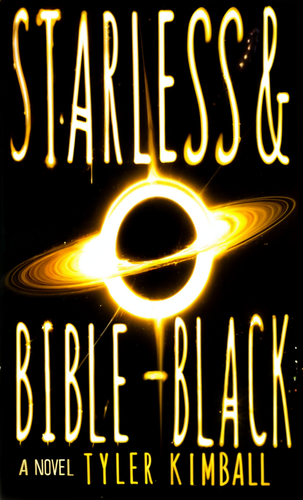
Starless and Bible-Black is a collection of interconnected stories set in the Starscape, the last planet at the end of time, built from the corpses of dead galaxies and populated by everything that survived the death of the universe. It's home to bored immortals, impossible aliens, diminished gods, corporate demons, and a crew of investigators trying to bring something resembling justice to a cosmos that no longer makes sense.
Put like that, it sounds like prose on acid... and it actually is.
The prose is lush to excess. Every paragraph overflows with neologisms, erudite references (from Byron to King Crimson, from Lovecraft to the Platters. And surely dozens more I didn't catch), and worldbuilding layered like a cake of cosmic information. A character doesn't simply enter a room: they cross impossible architectures laden with trillions of years of history while the narrator explains the biology of three alien races and the politics of five warring factions.
What Works
Most of the time, it works. The story Dutch Pink that opens the collection is a small masterpiece of weird fiction: a man with divine blood who can be killed but reforms, enters the fortress of a Martian warlord to propose a "landscaping job." It's violent, sarcastic, and... damn, it's moving.
The Scholar of Tragedies succeeds remarkably at rendering a non-human point of view genuinely alien — something extremely rare in science fiction.
What Doesn't
Other times, the density suffocates. There are sections where encyclopedic worldbuilding buries the story under layers of invented terminology. The cast is so vast that even by the end some characters remain somewhat flat.
When Kimball works, he works brilliantly.
This is not a book for everyone. Damn, it makes you wonder the opposite: whether the reader is good enough for the book, not the other way around!
It's strange, it's dense, it's occasionally frustrating. It's also genuinely original, something increasingly rare.
I consider writing a craftsman's path. I hate talking about art; I find it pompous and self-centered. But with Starless, you can't talk about craft. This is truly a work of art.
ARC copy received in exchange for an honest review.
Comments