
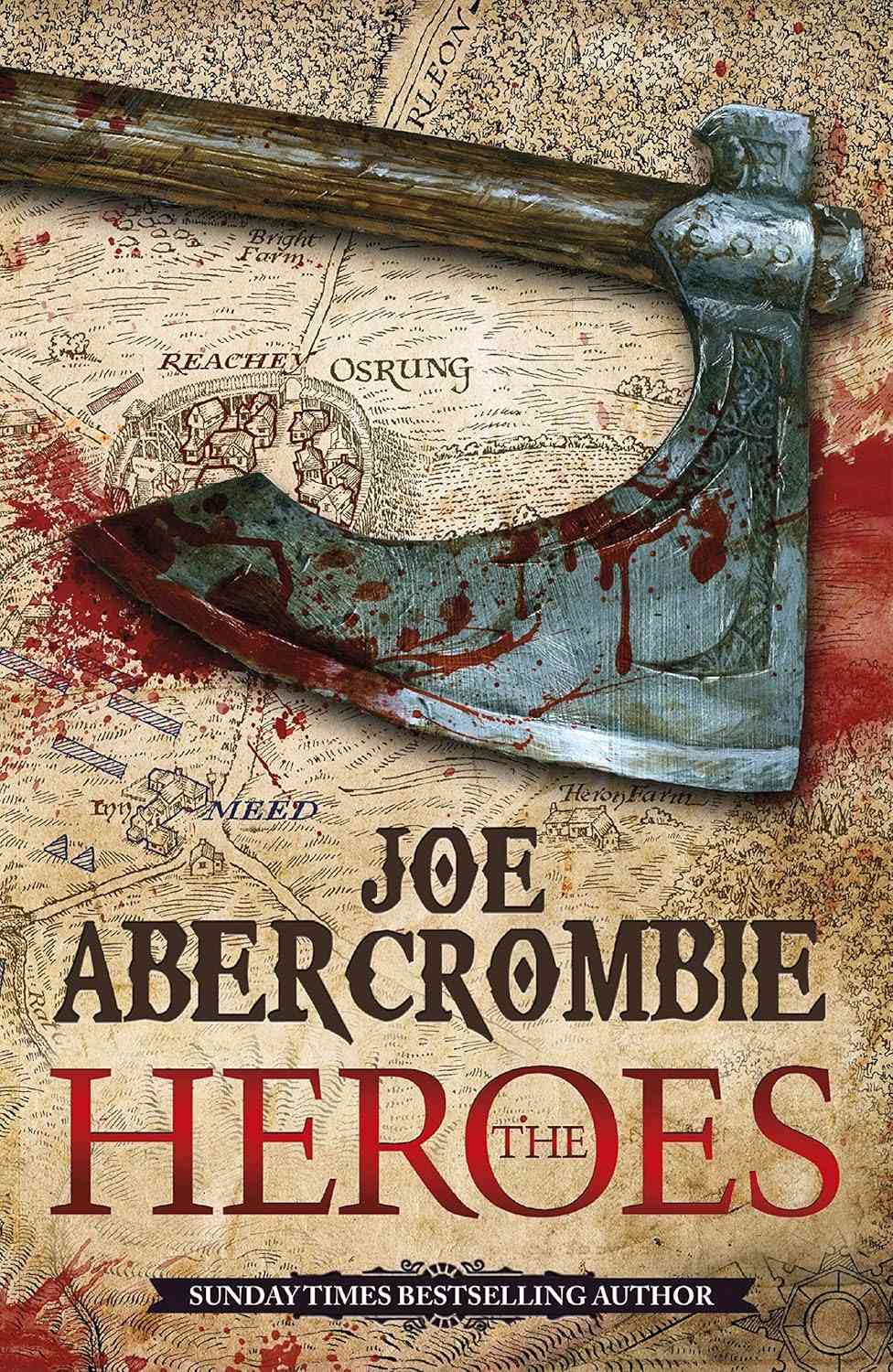
Three Days, Twelve Perspectives, Tons of Grimdark!
I read this book to study a master. I came out with a list of techniques I'm stealing and a deep respect for what's possible with multi-POV grimdark.
The Heroes is a novel about a battle. That's it. Three days of fighting over a circle of standing stones called the Heroes — which is already Abercrombie's first joke, because the only heroes in this book are rocks.
The premise is Aristotelian in its unity: one place, one event, a compressed timeframe. But within that constraint, Abercrombie deploys twelve point-of-view characters across both sides of the conflict. The Union army invades the North. Northmen defend. People die badly, mostly for stupid reasons, and the survivors have to live with what they've done.
What makes this work is the structural precision. Every POV is necessary and every character represents a different relationship with war: the old veteran who's tired of killing, the young recruit who dreams of glory, the politician who hates violence but craves power, the berserker who's already dead inside, the competent officer surrounded by idiots. Each one gets enough space to become real, and then Abercrombie puts them through the meat grinder.
The pacing is relentless! Abercrombie alternates scene types systematically — action, then reflection, then political maneuvering, then a moment of humanity, then back to action. You never get two scenes of the same kind in a row. The book never stops moving, but it never feels rushed either.
Abercrombie uses a technique I've never seen done this well: mirrored POV chapters where two characters think the exact same thoughts about each other. Colonel Felnigg despises General Mitterick as "an arrogant pedant without imagination." Three pages later, Mitterick despises Felnigg as "an arrogant pedant without imagination." Same words. The author never intervenes to tell you who to trust — he just shows you that everyone thinks they're the reasonable one.
(Okay, I know it sounds like a gimmick when I put it that way, but read it. I assure you, Joe did it damn well!)
There's a phrase-mantra that runs through the whole book: "It's the sign of the times." Different characters say it in different contexts. The phrase never changes, but the meaning shifts with every speaker. That's structural irony — the author builds meaning through repetition and contrast, not through commentary.
The anti-war message is clear but never preachy. War is shown as a system that grinds people up regardless of their intentions. Orders get lost, heroes die by accident and battles are won through luck and lost through miscommunication.
Is this book perfect? Well, nothing in the world is perfect, but Heroes comes dangerously close! The worldbuilding is efficient but conventional — Abercrombie's North is essentially Vikings with extra cynicism. Subjectively, I admit that this kind of setting has tired me, but that’s MY flaw, not Abercrombie’s. Btw, if you haven't read the First Law trilogy, some references will feel opaque.
This is benchmark-level work. Abercrombie proves that you can maintain quality across 200k words, that twelve POVs can all feel distinct and necessary, that structural techniques can create meaning without the author ever raising his voice.
Holy crap, I came to this book as a student, I left with homework.
Abercrombie writes about war. I write about survival.
Different settings, same principle: ordinary people making impossible choices. The Motherverse is built on that foundation.
Discover Ravenous Mother →Want to steal these techniques for your own writing?
I broke down exactly what makes this book's structure work — mirrored POVs, phrase-mantras, time constraints, and more.
Read the Craft Analysis →
Comments