

I started this book expecting another "reluctant chosen one" and found something stranger, colder, and more interesting.
Cynriel is a man who refuses the throne in the prologue — literally turning his back on the crown in a public ceremony — and spends 40 chapters dealing with what that refusal means when the world insists on assigning him a role anyway. He's not an antihero hiding a heart of gold. He's not a coward learning courage. He's simply someone who has seen what it means to rule and said no, without being able to escape the consequences of that no.
The Prose
The prose is the most evident strength — a dry, percussive cadence that turns every scene into a series of millimeter-calibrated observations. It's also, paradoxically, the most evident problem: after the hundredth paragraph built by subtraction, the reader desperately wants a subordinate clause.
Sample Style
"Stone holds cold the way water holds weight."
"Not clasped. Not folded. Nothing that can be read as devotion."
Every sentence is chiseled. Every paragraph compressed. The technique is deliberate and consistent across 94,000 words — which requires rare discipline.
What Works
The journey from the capital to the mountain monasteries is the weakest section. Too many chapters where the group walks, camps, encounters civilians in difficulty, and departs again. The worldbuilding emerges organically — the six-legged thrennels, the Regalys as a diplomatic-priestly corps, the prophecy of the Unworn Crown — but the action stagnates.
Where the book redeems itself is in the handling of moral tension. Cynriel isn't tormented by impossible choices in a melodramatic way. He's simply forced to exist in a space where every decision (help, don't help, stay, go) has real costs. And Ashborne has the maturity not to resolve anything with a cathartic climax.
The ending — Cynriel walking out of the city while the others begin to build something that doesn't include him — is perfect in its quiet inevitability.
The Cover
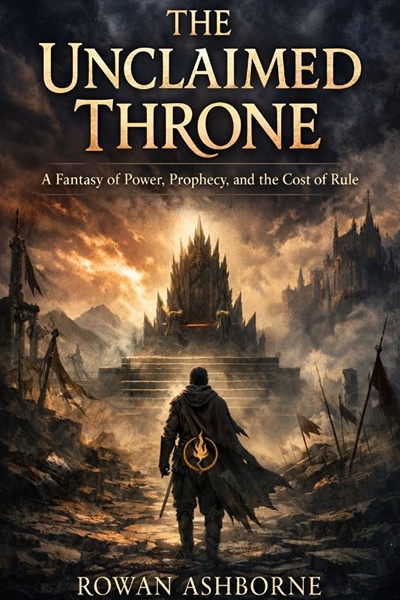
A solitary figure walking toward a ruined city, apocalyptic orange sky, desaturated palette. Professional composition, cohesive palette, readable typography. The weakness: it's generic. It could be any epic fantasy. It doesn't communicate the "refusal of power" that is the book's heart.
Recommended for those seeking dark fantasy without gratuitous grimdark, for those who love stylized prose and protagonists who think more than they fight. Not for those who want tight action or explosive worldbuilding.
A technically competent book with a strong authorial voice, but suffering from the classic problems of the "ambitious first novel" — too long for what it has to say, uneven pacing, weak commercial hook. The author has talent. The book is good but not exceptional. Worth keeping an eye on for subsequent titles.
What happens when you refuse power — but power refuses to let go?
Ashborne explores the cost of saying no. In the Motherverse, debts don't expire — and every favor has a price carved in flesh.
Read: The Akhenasi →
Comments