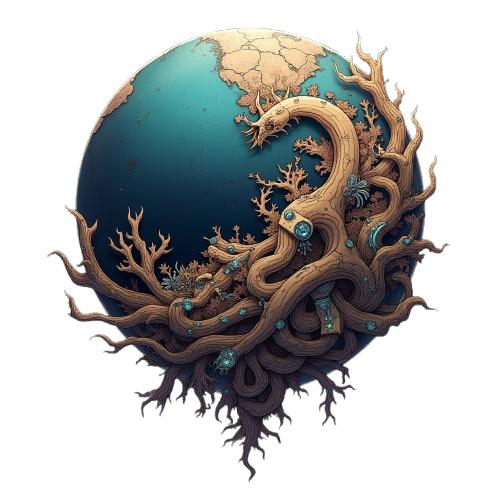

Life in the Sac: Living Inside a Body
Imagine waking up in a world without sky.
The walls of your home pulse gently with a rhythm you've known since birth. The floor beneath your feet is calcified tissue, smooth and warm. The light filtering down comes not from a sun you've never seen, but from glowstones embedded in the vault above—a ceiling of living membrane studded with bioluminescent organs that brighten and dim in cycles that define your days.
This is the Sac. This is home.
A World of Flesh
Everything in the Sac is biological. The concept of "inorganic" barely exists—there are no rocks, no metals, no minerals as the outside world would understand them.
Buildings are not constructed—they are grown. Architects coax living tissue into shapes suitable for habitation, cultivating walls from membrane and growing furniture from fungal structures. The fungus-chairs in a common home are alive, slowly metabolizing, requiring occasional feeding. The valve-doors that separate rooms open and close in response to pressure and pheromones. Nothing is truly still. Nothing is truly dead.
The Rhythm of Days
Time in the Sac is measured by the glowstones. These bioluminescent organs embedded in the vault brighten gradually to signal morning, hold their light through the working hours, then dim into the amber glow of evening before fading to near-darkness for sleep. The cycle is regular enough to build society around, though not perfectly precise—sometimes the glowstones flicker, sometimes they hold their brightness longer than expected.
No one knows why. The glowstones are part of the Mother. She keeps her own time.
The Stagnation
Periodically, the Sac enters a state called the Stagnation. The air grows thick and hot. The membranes pulse more slowly. The glowstones dim to a sickly yellow. Breathing becomes difficult. Tempers fray. Disease spreads more easily. The Stagnation can last days or weeks, and everyone simply endures until it passes. It is one of the Mother's cycles, as natural and unavoidable as the tide in a world with oceans.
Getting Around
The Sac is vast—large enough to contain a city, suburbs, the professional quarters with their towering monuments, and the peripheral zones where gatherers work the membranes. Walking everywhere is impractical. Fortunately, the Mother provides.
Worms
The primary public transportation of the Sac consists of worms—massive creatures with translucent, gelatinous bodies. They secrete a viscous fluid that lets them slide smoothly through the organic corridors, while their backs exude a different substance that allows passengers to adhere without slipping. Worms follow established routes, stopping at designated stations where people climb on and off. Riding a worm is mundane, unremarkable—just part of daily life, like taking a bus in another world.
Food and Sustenance
The Mother feeds her children, but not generously.
Greenbread
The staple food of the Sac is greenbread—a pale green substance with a crunchy exterior and soft interior, produced by specialized glands in the Mother's tissue. It contains all nutrients necessary for human survival. It is distributed according to social rank: nobles receive the freshest, most nutrient-dense portions; commoners get what remains. During times of scarcity, greenbread is diluted with less nutritious substances, maintaining the appearance of adequacy while slowly starving those at the bottom.
Beyond greenbread, there are gathered foods—fungi and the occasional protein from creatures that live in the deeper passages. The wealthy eat better, of course. Some nobles have access to foods that commoners have never tasted, never even heard of. This too is part of the order of things.
The Edges of the World
Beyond the settled areas, past the peripheral zones, lies the Greater Membrane: a vast organic barrier that marks the edge of the known world. Most people never see it. Those who work near it—gatherers, cartographers—know that the geography shifts there, that passages open and close without warning, that creatures prowl in the dim spaces between membranes.
What lies beyond the Greater Membrane? The faithful say it is the Mother's sacred body, forbidden to human presence. The practical say there is nothing—just more tissue, more membrane, the endless internal anatomy of a being too vast to comprehend. Some whisper other possibilities, but such whispers are dangerous.
The Texture of Existence
Life in the Sac is not miserable by default. People love, work, raise children, pursue ambitions, find moments of joy. Artists create forbidden beauty. Healers save lives. Families gather for meals. Children play in the corridors.
But everything happens under the weight of what the Sac is: a world inside a body, a society inside an organism, an existence that depends entirely on the entity that surrounds it. The walls pulse. The air tastes of flesh. The countdown to forty ticks in every heartbeat.
This is normal. This is home.
Comments