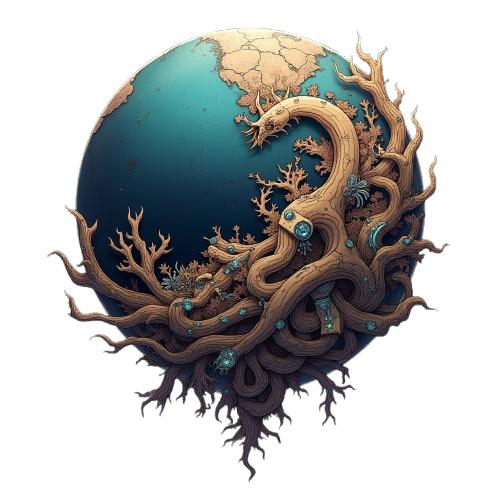

Professions of the Sac: Marked for Life
In the world of Ravenous Mother, you don't simply choose a career. Your profession is carved into your flesh, displayed in modifications that cannot be hidden or undone. From the moment you are marked, everyone who sees you knows exactly what you are—and what you can never become.
This is not metaphor. This is literal.
Caste Systems in Fantasy Fiction
From the houses of Westeros to the factions of dystopian futures, fantasy and science fiction have long explored rigid social hierarchies. But most caste systems in fiction are invisible—you can hide your origins, pass as someone else, escape your birth.
Not in the Sac. Here, your caste is written on your body. There is no passing, no hiding, no escape. This takes the familiar trope and makes it viscerally, inescapably physical.
The Hierarchy of Flesh
Society in the Sac is divided into rigid strata. At the apex stand the nobles, their status proclaimed by elaborately pierced earlobes—the more perforations, the higher the rank. The greatest nobles have lobes split into delicate fringes that cascade onto their shoulders, adorned with iridescent membranes and carved cartilage.
Below the nobility come the professions: specialized castes that perform essential functions for society. Each profession has its own quarter, its own tower rising above the city, its own traditions passed down through generations. And each has its own mark.
At the bottom are the commoners—unmarked, unremarkable, expendable. They do the work that no profession claims: gathering food, maintaining structures, existing until their Selection at forty.
The Recognized Professions
Healers
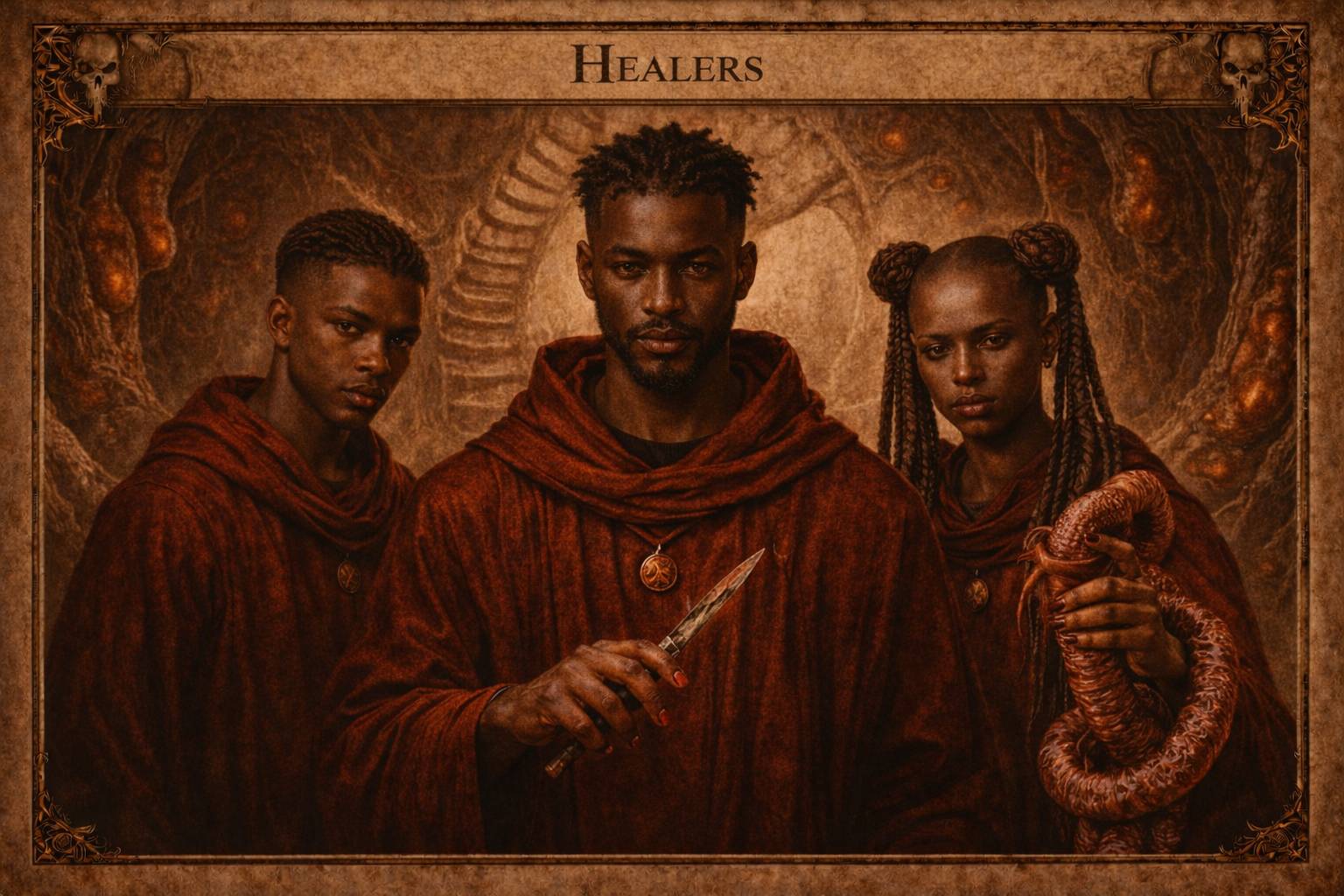
Mark: Crimson fingernails, permanently stained by the fluids they work with.
The Healers are physicians, surgeons, and keepers of biological knowledge. They operate according to Four Protocols that govern every aspect of their practice—from the sacred duty to the Mother, to the controversial Fourth Protocol whose true meaning is revealed only to the highest circle. Their tower houses the Chamber of Pain, where "intensive teaching" takes forms that would disturb outsiders. Healers are respected, feared, and never fully trusted.
Unveil the Healers of the SacGuardians
Mark: Teeth filed to serrated points, with glyphs inlaid into the enamel itself.
The Guardians are enforcers, soldiers, and keepers of order. Their sharpened teeth serve as constant reminder of the violence they are authorized—and expected—to inflict. The glyphs carved into their teeth are their own form of writing, each symbol carrying meaning that only they can read. They patrol the streets, guard the nobles, and ensure that the laws of the Sac are followed. When the Selection claims someone unwilling, it is often the Guardians who drag them to the maw.
Cartographers
Mark: Elaborate crests adorned with colored ribbons, with the rest of the skull shaved clean.
The Cartographers map the ever-shifting geography of the Sac—the membranes that move, the passages that open and close, the dangerous regions near the Greater Membrane where strange creatures roam. They carry tendon-guns, living tools that shoot organic cables to help them climb the vast biological structures. Cartographers venture where others fear to go, and many do not return.
Architects
Mark: Tattooed foreheads bearing the symbols of their craft.
The Architects shape the living tissue of the Sac into structures fit for human habitation. They coax membranes into walls, grow buildings from biological foundations, create the infrastructure of civilization from the flesh of the Mother herself. Their work is part construction, part cultivation, part communion with living material.
Not all professions have survived the centuries. Some have decayed, their knowledge lost, their towers fallen into disrepair. Others have been actively suppressed.
Artists
Mark: Parallel scars on each cheek—one line for initiates, two for qualified apprentices, three for masters.
The Artists were officially abolished generations ago, yet they persist in the shadows. They create works of living pigments that shift and breathe, sculptures of shaped tissue, performances that manipulate light, sound, and pheromones. Their art is considered dangerous—capable of stirring emotions, revealing truths, challenging the order. To be an Artist is to exist in a state of barely tolerated illegality, always one accusation away from Selection.
The professions enjoy privileges that commoners can only dream of: specialized knowledge, respected status, quarters in the better parts of the city, their own towering monuments to their importance. A Healer walks differently than a commoner. A Guardian commands fear. A Cartographer carries mysteries.
But these privileges have limits.
The professions are still subject to the Selection. When you turn forty, your crimson nails or sharpened teeth or scarred cheeks will not save you. You will be fed to the Mother just like any commoner. Your tower will remain; you will not. The nobles watch generation after generation of professionals rise, serve, and die—while they live on, unmarked by anything but the holes in their ears that mean they are above it all.
In a world where your profession is visible to everyone, there is no escape from what you are. A Healer cannot decide to become a Guardian. An Artist cannot pretend to be a commoner—their scars betray them. The marks that grant identity also create cages.
Some see this as stability: everyone knows their role, their place, their purpose. Others see it as the ultimate form of control—a system where rebellion is written on your face before you even consider it.
The professions of the Sac are not just jobs. They are destinies carved in flesh, identities that cannot be shed, lives defined before they are fully lived.
Comments