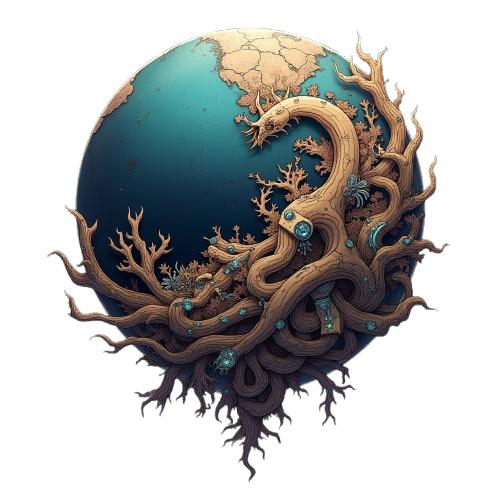

Mortesève by Quentin Rigaud: Mythological Biopunk from French Comics
If you've spent any time on this site, you've probably worked out that I like biopunk. It's not my only passion — though I imagine you'd find it strange, maybe interesting, to read my take on Vivaldi, Esperanto, or homemade sushi (yes, I go broad). I write about what moves me, whether that's a book, a song, or a film. Today it's a graphic novel: Mortesève by Quentin Rigaud. And I'll do it the way I always do: no time wasted — yours or mine. On y va!
Mortesève is a three-volume comics series (Casterman, 2023–2026) that constructs an entire organic cosmology around nine colossal divine creatures called the "Instruments," which regulate the cycles of nature. It is, in my view, one of the most ambitious examples of biological worldbuilding in contemporary European comics — and a privileged case study for understanding how biopunk has evolved: away from chrome-plated cyberpunk dystopias and toward ecological, organic narratives.
I have read the first two volumes. As of April 2026, the third is almost here.
One sad note: the series exists only in French. My French is not great — I'm more of a sushi person. But I made a rule years ago: comics — bandes dessinées, BD — only in French. Dictionary in hand, slowly, I learned to read them. I've even graduated to the occasional book. Ordering a pain au chocolat in a Parisian brasserie, however, remains Dantesque punishment. The fact that French speakers don't help people who try to speak their language is not a stereotype: it's a documented social phenomenon.
If we learn a language from our parents, my adoptive French father is Léo. And Quentin Rigaud — younger than me — is a kind of uncle who didn't know he had me. Surprise, Quentin.
(I've gone on about French BD because I plan to write a whole separate article on it one day. The French comics world is extraordinary, and biopunk reigns across a startling number of works. The French may be merciless about pronunciation, but they know how to build things that last. Back to Rigaud.)
How to Read This Article
When something interests me, I tend to lose the gift of brevity. So I've divided this into three parts. Choose your depth:
Part 1 — Review. What Mortesève is, why you should read it, no heavy spoilers. If you just want to know whether it's worth it, stop here.
Part 2 — Analysis. Why Mortesève matters as a biopunk work, who Quentin Rigaud is, and the editorial story behind volume three. For those who want to understand why this work counts.
Part 3 — Ravenous Mother. Points of contact and divergence with my own saga. For those already in my ecosystem, or just entering it.
Part 1: Review
Nine Instruments, Sacred Sap, and a World Without Metal
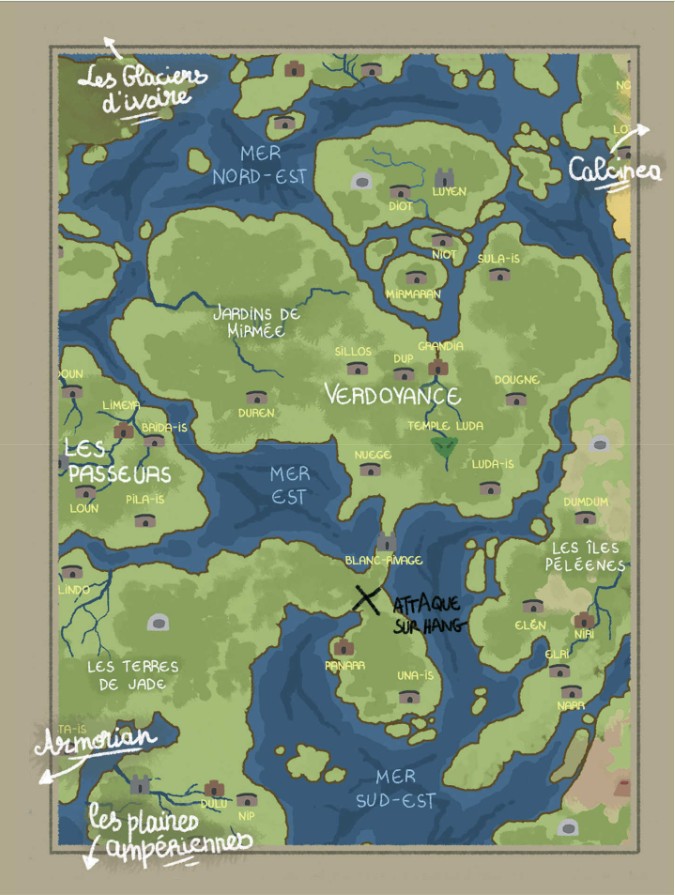
Mortesève unfolds in a world governed by nine enormous, quasi-divine creatures called the "Instruments," each named after a musical instrument — Hang, Orgue, Harpe, Konga, and others still unnamed. The Instruments move through the world in ten-year cycles, each one regulating a fundamental natural force: Hang governs fertility, Orgue governs death, Harpe is associated with water and glaciation. Konga remains a mystery for now, and I am enormously curious.
They are normally invisible to humans — except for Hang, whose body has been painted green to make it visible.
At the center of everything is the sève — the sap of the Instruments. It is a catalytic substance with healing properties, inspired by the Japanese art of kintsugi: the technique of repairing broken ceramics with gold. The sap heals — but like every precious resource, someone decides it's worth extracting by force.
SPOILER — Click to expand
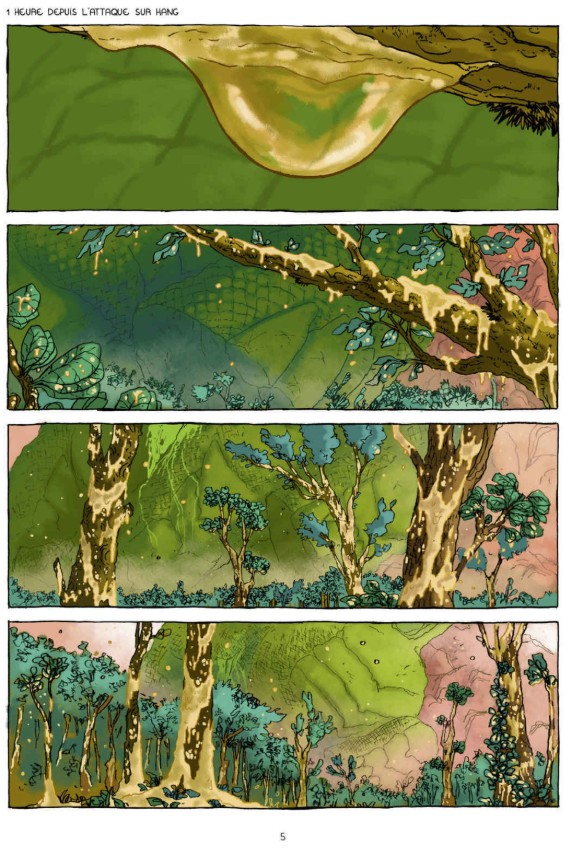
When soldiers attack Hang to drain its blood for supposed medicinal uses, the natural equilibrium shatters. Hang dies. Nature responds: the Mortesève — a lethal sea of toxic sap — floods plains and forests, becoming increasingly hostile to all living things.
This is the central ecological parable of the series: exploit the biological system that sustains you, and it transforms into something lethal.
The protagonist, Avine, accidentally exposed to the sap as a child, develops mysterious powers. Her brother Kahl is a more enigmatic figure, who will eventually become a guardian of Hang — the role Avine had wanted for herself.
From the very first volume, the narrative is movement. Avine's family travels. Avine travels alone after the spoilered events above. They travel toward Hang, toward the Instruments, toward salvation and, in part, toward revenge. The journey has a precise destination, but the road becomes as important as the arrival. The tone is neither grimdark nor YA. It's something undefined, halfway between the two.
And that indefiniteness is wonderful. Did you ever discover a band as a kid — Nirvana, cough cough — that you loved deeply, while sensing it was somehow too "adult" for you yet? And then twenty years later you listened again and thought: yes, now I understand this properly.
I discovered Mortesève at the edge of forty. It gave me exactly that feeling.
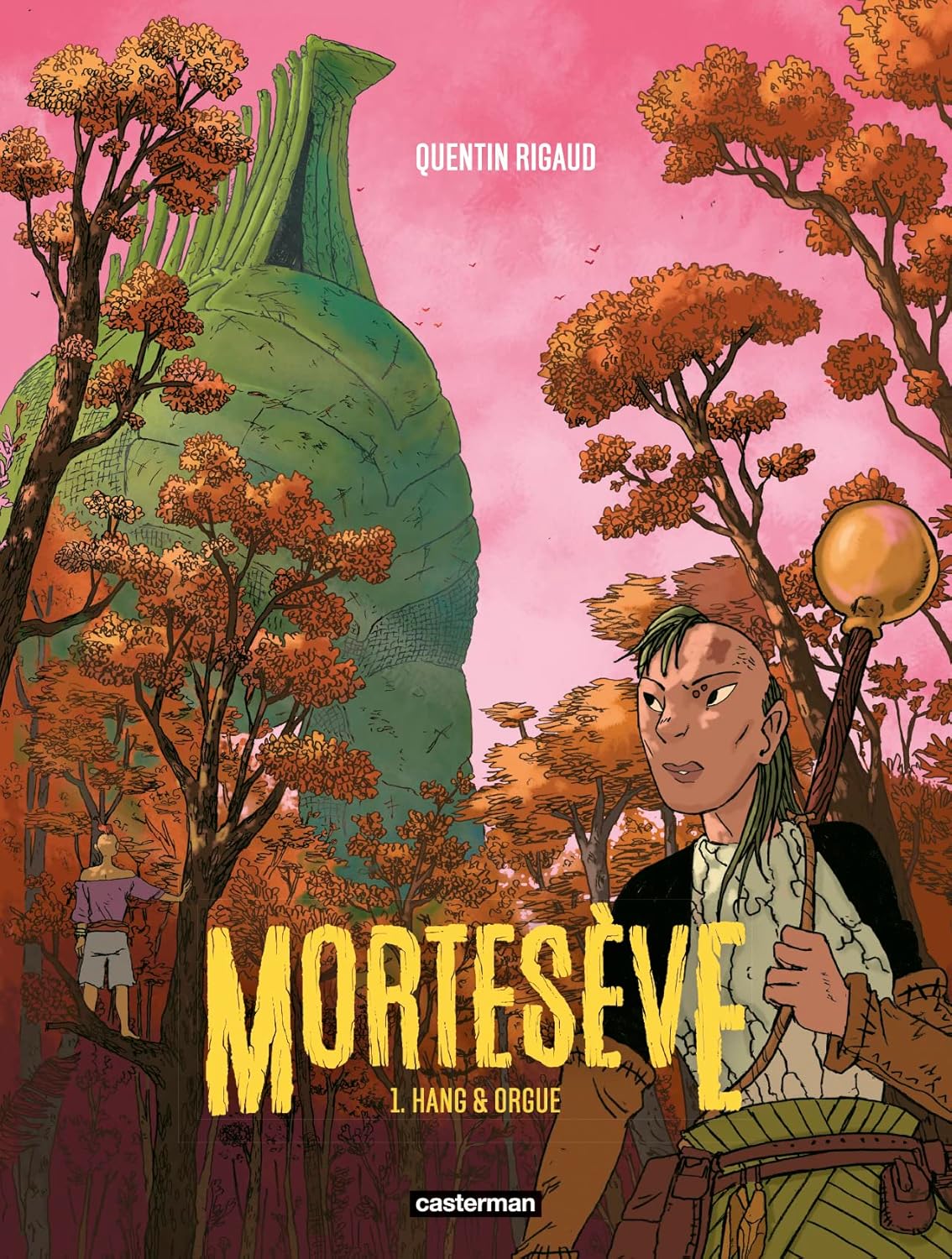
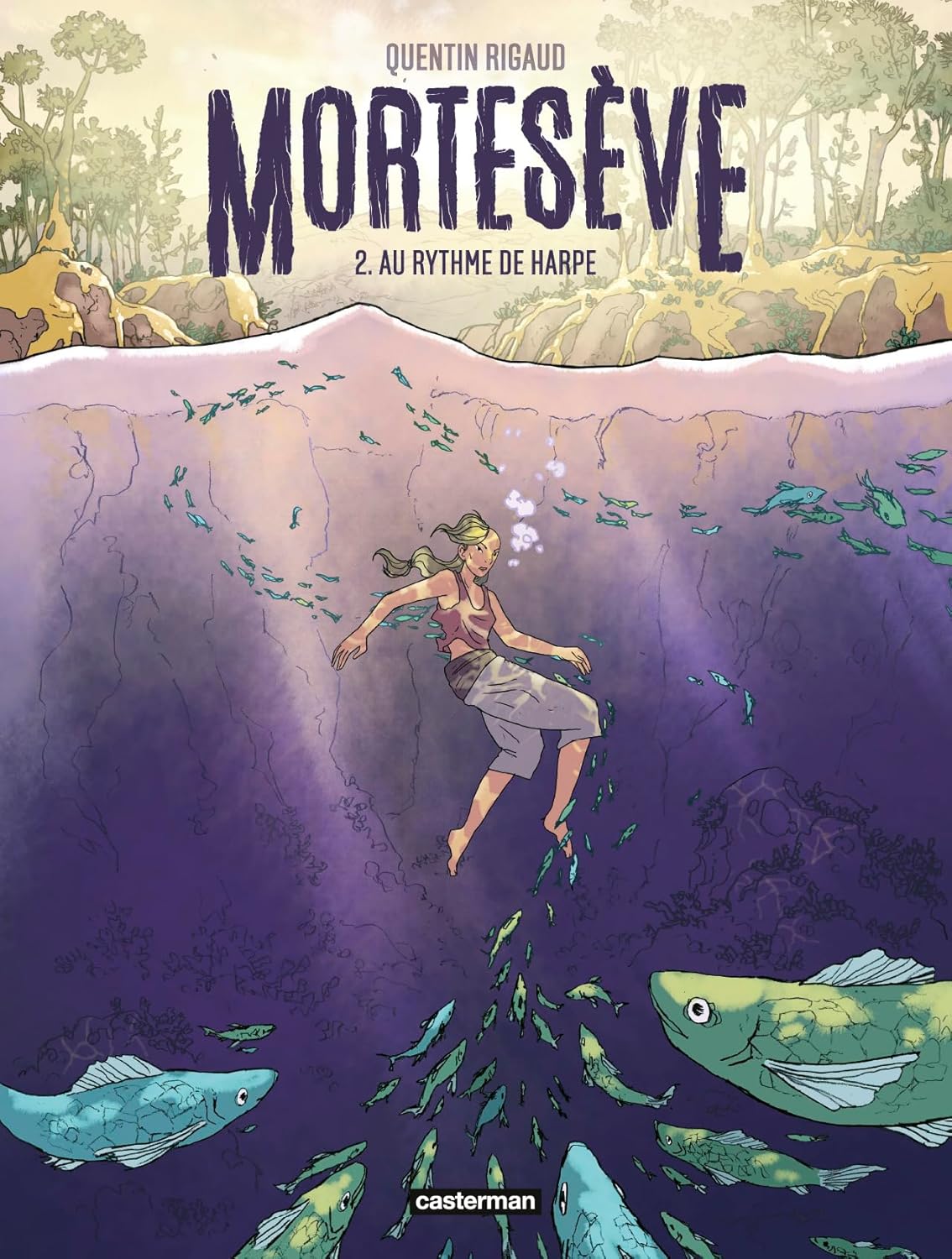
Rigaud's linework is organic in the most literal sense. Every character looks grown rather than drawn — proportions slightly off-scale, hair that behaves like branches, expressions that seem to bloom rather than be constructed. There is something ineffable, almost sensual in his panels that is difficult to put into words but immediately felt.
It's no surprise that this style divides readers. Professional critics receive Mortesève with near-unanimous enthusiasm. Planète BD awards the first volume a perfect score — Chef d'œuvre, four stars out of four — praising both the writing and the visual architecture. ActuaBD calls it a magnificent initiatory tale and notes the second volume is even more refined than the first. Comixtrip, Métal Hurlant, Biblioteca: all positive. The blog La Ribambulle ends with one of those phrases that sticks: "une véritable réussite qui confirme tout le bien que l'on pensait de Quentin Rigaud."
The readership is more divided. On BDThèque two reviews average 2.5/5, with one reader finding the character art at fanzine level, not professional. (Probably not a Nirvana fan. Everyone has their tastes.) On Amazon.fr the rating is perfect. Babelio falls in the middle — praise for the lush flora, some reservations about linework that's "un peu raide." As often happens: critics see the work; readers see the characters. Both are right.
Consistent praise: the rich and original worldbuilding, ambitious ecological themes, lush botanical art, non-Manichean character morality. Recurring criticisms: pacing — some drag — and a few panel transitions that aren't as clear as they could be.
Mortesève has not yet received any official award or nomination. It doesn't appear in the Angoulême selections. There are no reviews of it in English, or any other language. The series remains invisible outside the Francophone BD ecosystem.
That is a genuine shame.
If you're interested in organic worlds, ecology as narrative, fantasy that doesn't settle for the usual elves — read Mortesève. If you want to see what European comics can do when they dare — read Mortesève.
The problem: no English edition exists. For now it is only accessible in French. But if you read French, or are willing to try with a dictionary — as I did — it is worth the effort.
(I'm biased, but do it. Read in French. There is INCREDIBLE stuff in the BD world. And learning new things never hurt anyone.)
Part 2: Analysis — Mythological Biopunk
If you wanted just the review, you can stop here. What follows is for those who want to understand why this work matters in the context of the genre.
French bande dessinée has a deep tradition of speculative biological worldbuilding. Moebius created visionary alien ecosystems. Enki Bilal explored corporeal dystopias in the Nikopol Trilogy. Mathieu Bablet in Shangri-La built worlds of genetic hybrids and DNA-controlling corporations. And then there's Léo, with alien worlds where life intertwines with human colonizers in a framework that is MUCH more fascinating than anything Avatar managed.
Mortesève belongs to this lineage — but pushes even further toward a purely biological cosmology. Its world contains no mechanical technology: everything is organic. The Instruments are living biological regulators. The sap is a substance with near-magical properties. The Mortesève itself is a toxic organic flood, not industrial pollution.
Why This Is Biopunk
Biopunk is living through unprecedented cultural urgency. CRISPR-Cas9 — for those unfamiliar: a revolutionary genetic editing technology that allows precise cutting and modification of specific DNA sequences — won the Nobel Prize in 2020; the first CRISPR-based gene therapy received FDA approval in 2023. We have narrative experiences like Vesper (2022), Cronenberg's Crimes of the Future (2022), Scavenger's Reign (2023) — the genre is expanding, contaminating ecological fantasy, hybridizing with solarpunk.
We have Kameron Hurley, which says everything.
Mortesève might not look like biopunk at first glance. There are no laboratories, no megacorporations, no genetic engineering in the conventional sense. Then again, there aren't any in Ravenous Mother either.
The world of Mortesève contains no metal, no silicon. The Instruments are the infrastructure — they are, in every meaningful sense, living biological systems regulating death, fertility, glaciation. The craquèlement pourpre — the disease that splits bodies from the inside — is classic body horror. Avine is biologically modified without consent. The Mortesève is body horror at planetary scale.
The central conflict is built on people extracting biological material for their own ends, devastating the ecosystem. In traditional biopunk it's pharmaceutical corporations; here it's a mysterious sect (at least through volume two). The outcome is identical either way.
Casterman has also explicitly positioned the series as a response to climate disruption and the deadly impact of humans on their environment.
And there is one element that distinguishes Mortesève from pure dystopia: the kintsugi. Rigaud's declared inspiration suggests that biological damage can be repaired with something precious. The sap that devastates is the same one that heals. Scars can become gold.
I'm curious to discover whether volume three will offer a final kintsugi — a world repaired, different from what it was before, but perhaps more beautiful precisely because of it.
Quentin Rigaud: The Comics Artist Who Draws Like Plants Grow
Born in 1992, Rigaud works under the pseudonym Slanmetha. He studied at ESA Saint-Luc in Brussels and completed a Master's in Bande Dessinée at EESI in Angoulême — the same school that has trained generations of BD authors.
His debut was Stigma — Odyssée Sporale (Casterman, 2022) — a graphic novel of 736 pages, created in part as a livestream on Twitch over several years. Before Mortesève, he had already demonstrated capacity for biological worldbuilding at monumental scale.
His method is as organic as his subjects. He uses mechanical pencil on smooth paper and describes his character design as "drawing characters like plants" — organic forms that grow on the page rather than being constructed geometrically. He collaborates with colorist Kathrine Avraam, whose philosophy can be summarized as: "the sky can be yellow or green" — atmosphere matters more than realism.
Rigaud is also a streamer: part of the creative process unfolds live on Twitch, shared in real time with his community. This is not a marginal detail — it's consistent with his vision of art as a growing organism, a symbiosis between author and audience.
Eighty Unpaid Pages
The first two volumes of Mortesève did not achieve the commercial success Casterman had anticipated. The publisher decided not to continue the series.
Rigaud negotiated to conclude with a single final volume. He proposed expanding volume three from the planned 130 pages to approximately 210 pages — adding 80 pages to close the narrative as it deserved. Those 80 extra pages are unpaid.
In an interview with Comixtrip (January 2025), he said: "Je suis déçu, mais je voulais finir Mortesève sans regret" — I'm disappointed, but I wanted to finish Mortesève without regrets.
If the measure of an author's respect for their readers can be counted in pages given freely, Rigaud did not hold back. Kudos.
Part 3: Ravenous Mother — Two Answers to the Same Question
This section is for those who already know my work, or who are curious to understand why a biopunk dark fantasy author is writing about a French graphic novel.
I discovered Mortesève as a reader. I'm writing about it as an author. My saga Ravenous Mother takes place inside a titanic organism called the Mother. A rigidly stratified society lives within her cavities, feeds on what it finds in the Greater Membrane — the long perimeter surrounding the Sac — and builds houses that sprout like fungi from the flesh.
Loosely, Ravenous Mother and Mortesève share the same question: what does it mean to live in symbiosis with an organism that completely dwarfs you?
Anyone who writes about biological worlds — where flesh is architecture and blood is metaphor — recognizes in Rigaud a kinship.
In both worlds, the giant body is simultaneously physical universe, source of nourishment, and divinity. Biology is the fundamental power system. Rigaud's sap and the Mother's secretions serve analogous functions: nourishment, control, mystery. Both explore survival and identity within a system that entirely overwhelms the individual.
But: Hang passes. The Mother contains.
Rigaud's Instruments are nomadic. They traverse the world in ten-year cycles, indifferent but not oppressive. Hang brought fertility; its death is a catastrophe. The world of Mortesève was in equilibrium: the symbiosis worked.
In Ravenous Mother — the Mother is permanent and totalizing. She doesn't pass — she is the world. There is no "outside." The society is dystopian from the start: rigidly classist, with no harmony to mourn. The Mother has not been corrupted — she has always been a prison.
In Mortesève, repair is possible. The sap that devastates is the same one that heals. There is ecological hope — the system can be restored, scars can become gold.
In the Motherverse, hope is individual. Characters survive, sometimes even flourish, but the system does not change. There is no kintsugi — there is adaptation. The Mother cannot be repaired because she is not broken. She is exactly what she has always been.
Rigaud maintains an adventurous tone. I go harder into grimdark.
Mortesève is accessible — almost a dark fantasy with moments of lightness (or a fantasy with dark moments?), likeable companions, adventure that holds. It's a work you can recommend without too many warnings.
Ravenous Mother is more brutal. The dystopia is pervasive, the body horror more explicit, hope more scarce. It's not for everyone — and it doesn't try to be. My son won't be touching it for quite a few years yet, to give you a sense of scale.
I'm not saying one approach is better than the other. Contemporary biopunk is large enough to contain both — and the conversation between works, between languages, between narrative traditions, is precisely what the genre needs.
Mortesève demonstrates that biopunk themes can be translated into accessible fantasy cosmology. Ravenous Mother demonstrates that they can be pushed toward visceral dark fantasy. Both answers are valid. Both expand the genre's territory.
That's why I'm writing about a French graphic novel that most of my readers cannot read: because we are not alone. Because the same question is being asked in multiple languages, multiple media, multiple traditions. And because different answers illuminate what each of us is trying to do.
Mortesève does not yet have the visibility it deserves in the anglophone world. I hope this article contributes, even in a small way, to changing that.
And if you're curious to see how I answer the same question — in a darker, more visceral, more claustrophobic way — Ravenous Mother is waiting for you.
Sources & References
Mortesève — Casterman Editions
- Tome 1: Mortesève (May 2023)
- Tome 2: Au rythme de Harpe (January 2024)
- Tome 3: Jusqu'aux sillons de Konga (forthcoming 2026)
Quentin Rigaud — Profiles and Channels
- Bluesky: @slanmetha.bsky.social
- Twitch: slanmetha — where he livestreams his creative process
- Instagram: @slanmetha
Interviews and Articles Cited
- Comixtrip, interview with Quentin Rigaud (January 2025) — source for the quote "Je suis déçu, mais je voulais finir Mortesève sans regret" and the information on the 80 unpaid pages
- ActuaBD — reviews of Tome 1 and Tome 2
- Planète BD — review of Tome 1 (Chef d'œuvre, 4/4)
- La Ribambulle — "une véritable réussite qui confirme tout le bien que l'on pensait de Quentin Rigaud"
Other Works by Rigaud
- Stigma — Odyssée Sporale (Casterman, 2022) — 736 pages
- Le Tombeau de la Comète (Dargaud, January 2026)
- "Dans le jardin du Diable" in The Midnight Order (Label 619 / Rue de Sèvres)
Kathrine Avraam
- Colorist of Mortesève and contributor to the visual identity of Stigma. In an interview, Quentin Rigaud explained that her philosophy shaped his approach to color: “Il n’y a pas de raison à la couleur, le ciel peut aussi bien être jaune que vert.” He added that creating an atmosphere is more powerful than reproducing familiar colors realistically. Source
- Rigaud also credited Kathrine Avraam with creating the color palettes for the first fifteen covers of Stigma, saying that she “gave the first atmospheres” of the story before he later took over the coloring himself. Source
Léo (Luiz Eduardo de Oliveira)
- Author page on Amazon — Aldébaran cycle and later works (There’s almost too much to choose from... Lèo is PHENOMENAL!)
© J. R. Kendiro — kendiro.com | Images: © Quentin Rigaud / Casterman
Comments