

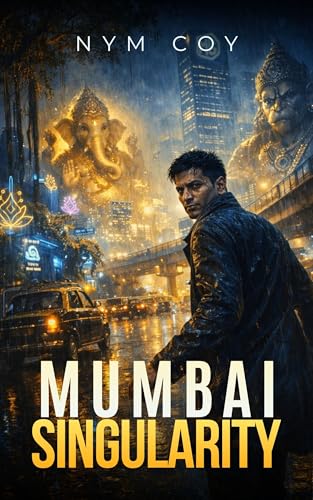
Yes, Yes, YES! This Is the Kind of Cyberpunk WE LOVE!
Indian cyberpunk with Hindu gods as emergent phenomena of the network. Inspector Krishna Mehta sees things others don't — like gods talking to him from the temples in his home.
We're in Mumbai, 2145. Inspector Krishna Mehta has a problem: the mesh antenna in his back is damaged, and when he goes into dropout he sees things others don't. Like an iridescent shimmer on people's foreheads. And… gods talking to him from the temples in his home. Yeah, Western readers: this is an Indian cyberpunk novel. Hell yeah!
What starts as an investigation into seven suspicious deaths in a hospital turns into a race against time to stop something I would really, really love to tell you about, but then Nym Coy would come after me, find me, and have my head crushed under the foot of an engineered elephant (ENGINEERED!).
This book does something I've never seen before: it treats Hindu gods as emergent phenomena of the network, memes that have become sentient through centuries of collective prayer. Ganesh, Hanuman, Lakshmi aren't metaphors. They're real, they have personalities, they crack jokes, and they're just as worried as Mehta about what's happening.
For those who've read American Gods, the parallels come naturally, but the comparison is more superficial than it seems.
The worldbuilding is outstanding. Future Mumbai is built with precise details that never slow the narrative down. We've got AR overlays, spinal meshes, engineered elephants (ENGINEERED ELEPHANTS!) holding up the city's infrastructure. And you start to wonder: what happens when someone hacks the divine?
It's all solid. Very solid. Nym Coy knows what they're doing. The book has a classic three-act structure, well-managed escalation of stakes, and a protagonist with a physical flaw that becomes a narrative superpower (the broken antenna as a device to see the truth is elegant).
Mehta is a good protagonist. Not extraordinary, but he works. He's pragmatic, ironic, with a touching relationship with his mother that anchors the whole story. Jay Sharma, the mentor, is the kind of character you'd want on your side if something bad happens. Ganesh and Hanuman are the best supporting characters I've read this year in indie books.
The pacing is tight for most of the story. Okay, maybe Act 2 occasionally suffers from avoidable slow moments (the collar-building, for example). Rahul and Neha are functional characters who don't leave much of an impression. The epilogue wraps everything up a bit too neatly. I understand the need to decompress after the climax, but it could have been leaner.
Honestly, I'm a bit tired of cyberpunk. Too many clones. It's starting to suffer from what happens to fantasy: someone wakes up and says "I'll write fantasy"… and off we go with castles, dragons, elves, orcs, wizards. Sure, it's enjoyable (otherwise we wouldn't see so many people writing it and so many reading it), but it's always the same things… cyberpunk isn't quite that saturated yet, but we're galloping in that direction.
Mumbai Singularity is the kind of cyberpunk book that makes you think, "the genre isn't dead yet, sir!"
Kudos, Nym Coy, I'll definitely keep reading you.
Gods as emergent phenomena. Biology as technology.
Nym Coy treats Hindu gods as products of collective belief made real by the network. In biopunk, biology is the network — and the divine is the organism you live inside.
Read: Biopunk — The Living Genre →ARC copy received in exchange for an honest review.
Comments