

How to Write Comfort Food, Climb the Indie Charts, and Not End Up a Hack
An honest analysis of Paul J. Bennett
See also: Read the review of Heir to the Crown.
This is an article written by an indie author, about how another indie author writes, for other indie authors. It's not a review. It's not criticism either. It's... an autopsy. An affectionate one, but still an autopsy. Sorry, Paul!
Before we talk about prose and "art," let's look at the facts:
- 48 books published (as of March 2026)
- 39,000+ ratings on Goodreads, with an average of 4.33 stars
- 4 interconnected series set in the same universe (Eiddenwerthe)
- International bestseller—selected as a "Top Indie Favourite" by Barnes & Noble
- Full-time indie author—lives exclusively from his writing (the guilty dream of many of us)
Bottom line: Paul J. Bennett sells like crazy. And I want to know why. He started in 2017 (not sixty years ago!) with Servant of the Crown. In less than ten years, he's built an indie publishing empire. As a software developer moonlighting in the indie lit scene, I can tell you: this isn't luck. This is method.

So who is Bennett? Born in England in 1961, emigrated to Canada at age six. Former Canadian Armed Forces. (There must be a golden thread connecting soldiers to literature—I keep meeting indie authors who are ex-military. Between the mindset and the educational opportunities, that's something worth analyzing someday.) His passion for storytelling was born from Dungeons & Dragons in his teenage years—and boy, does it show! His gaming campaigns became his books.
His first novel, Servant of the Crown, literally came from an RPG campaign. Bennett already knew the characters, their motivations, their arcs. He didn't have to invent anything: he just had to transcribe.
I haven't read his entire body of work (I already have two jobs and a toddler—I'm not on enough drugs to have that kind of energy). I read Heir to the Crown (books 1-3): Servant of the Crown, Sword of the Crown, and Heart of the Crown.
Even knowing this doesn't always help. For me, it just makes me grind my teeth... go check out my Books section!
My pitch is: "In a fully organic world called the Mother, humanity lives unaware of what lies outside. Their dystopian society, built on rigid social classes, exists in institutionalized violence, and hunger is everyone's eternal enemy." And that's just to start—just to explain a bit of background. Then for each novella and novel, I actually have to explain what happens, but if I don't explain the world first, nothing else makes sense.
Bennett's pitch for Heir to the Crown?
"A traumatized veteran becomes the guardian of a hidden princess."
One sentence.
The commercial hook is crystal clear. "Traumatized veteran + hidden princess" is understood in three seconds. You can put it on a cover. You can put it in an ad. You can explain it to your grandmother or your six-month-old nephew, who'll respond "guh?" but will have that gleam in their eyes of someone who totally gets it.
This is powerful stuff, folks. There's a reason fantasy is dominated by castles, wizards, and damsels in distress: people don't like having to work hard to understand what a book is about. Hell, a book shouldn't even have a deeper meaning!
I'm not trying to insult readers or criticize authors like Bennett—far from it. This is an honest analysis. I'm the first to understand what Bennett does, to know he does it deliberately, and to say I don't want to do the same thing... because I don't like it. Period. But I fully understand why he works for the mainstream and I don't. You've got to be honest with yourself in life.
Let's see what else works:
Gerald Matheson. He's the absolute strong point. A war-scarred sergeant who lost his wife and daughter, who finds redemption in protecting Anna. He's not a brilliant hero or a tactical genius. He's a tired man who refuses to give up.
Let me repeat that: a tired man who refuses to give up.
This is emotional comfort food (and it works), but that doesn't mean it's sloppy. It simply calls back to something we all know, a universal topos that stretches from Odysseus to the office worker punching his bus ticket on the way to work.
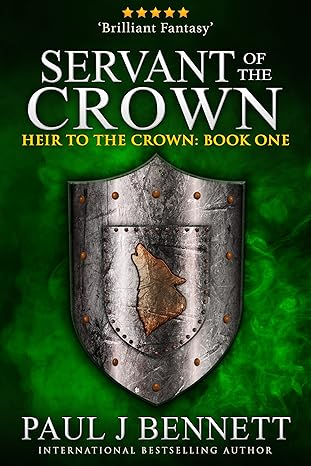
The pacing is solid. The first book covers thirty years elegantly—each chapter jumps forward in time, building the Gerald-Anna relationship without padding. It's efficient and professional.
The prose is invisible. This is highly subjective—it could be either a flaw or a strength. No sentence stops you; no passage makes you reread. Bennett writes to go unnoticed, and he succeeds. Efficient, never memorable. Honestly, I prefer this approach: a writer should tell a story, not show off that they know how to write. Technically, precisely because you don't think about the writer, you know they can write.
As for the worldbuilding... it's a collage of clichés. Eight schools of magic. Elves and dwarves. A standard medieval kingdom with court intrigue. There's nothing that distinguishes Merceria from Gondor, from Westeros, from a hundred other realms. And yet: it works. I can say whatever I want, have all my opinions, but it works. It sells.
The antagonists are placeholders. Functional but forgettable. They exist to be defeated, not to challenge the reader.
So what does Bennett know that many indie authors don't? Here's what I've figured out:
1. Comfort First
Bennett doesn't try to surprise. He reassures. His readers want lovable characters, familiar worlds, stories that confirm expectations rather than subvert them. This isn't an insult. It's a conscious strategic choice.
Most readers—the silent majority who buy books but don't leave elaborate reviews (leave an honest review for A Healer if you've read it! And if you haven't, go grab it here!)—aren't looking for intellectual challenges. They're looking for escape.
Bennett gives it to them. Every. Single. Time.
2. Long Series = Loyal Readers
Heir to the Crown has 15 books (plus spin-offs). The Frozen Flame has 8. Power Ascending has 8. Chronicles of Cyric has 4.
Once a reader enters the world of Eiddenwerthe, they have hundreds of hours of content to consume. It's an ecosystem. An emotional subscription.
In Kindle Unlimited, where you get paid per page read, this is a retirement fund.
3. Anchor Characters
That's what I call Gerald Matheson—an anchor character: someone the reader loves immediately and clings to throughout the journey. They don't have to be original. They have to be believable, three-dimensional, and lovable.
Bennett demonstrates (implicitly—I've never seen him standing on a soapbox with a megaphone) that readers get attached to people, not worlds. Worldbuilding is the backdrop. Characters are the reason to keep going.
Imagine what someone like me thinks about this—someone whose main saga is called "Ravenous Mother."
4. No Risks
Bennett doesn't experiment. Doesn't subvert. Doesn't challenge. And paradoxically, that's his commercial strength.
When you buy a Bennett book, you know what to expect. It's a brand. A promise kept.
Of course, there's a price to pay for comfort food: originality doesn't exist. In fifty years (thirty? twenty? ten?) nobody will be reading Bennett anymore. But he's done his job, and I'll say it again—he's not betraying anyone. He has a pact with his audience: I give you good stuff, you buy it.
It's a choice. But it means Bennett won't leave a mark on the genre. He won't change the conversation. He won't be cited.
The one thing I'll allow myself to criticize is the moral complexity. In his books, the good guys are good and the bad guys are bad. There are no ethical dilemmas that keep you up at night. That's fine, but we're in the twenty-first century, and it doesn't take lion-level courage to be a bit bolder. We're contemporaries of Joe Abercrombie—a little more effort to make characters realistic wouldn't hurt.
But again, I've only read three of his books. Maybe the next ten are a hymn to human complexity. I don't know.
In short: 48 books in less than ten years isn't just talent—it's discipline. It means treating writing like a job, not a hobby, and doing it damn well. I bow to such capability and hope to timidly reach that level someday.
Bennett also respects his audience. He doesn't talk down to them, doesn't preach, doesn't force political messages. He tells stories to entertain. Period.
His readers feel it. They appreciate it. They come back. It's that easy.
What We Should Steal
- Clear pitches — Even the most complex concept needs to be communicable in one sentence. My Motherverse is original, but I need to learn to explain it better. The last time I tried to explain it at dinner with friends, I realized I write better than I speak.
- Anchor characters — Gerald works because he's immediately lovable. Now, I don't think you necessarily have to make a character "lovable," but they need to evoke something right away. My Khulekani isn't lovable. God, he's the furthest person in the entire multiverse from being lovable. But he's interesting. He's a cross between Sheldon and Hannibal Lecter—you don't care about loving him, you want to know how far he'll go. If I could do that with all my characters, I'd be eating gold-leaf hamburgers every day.
- Series consistency — Bennett's covers are recognizable as a system. If you look at how he formats his books, they're clear, they're always identical, they tell you "someone who knows how to build a brand came through here."
I like Paul J. Bennett. Not as an artist (I hate calling a writer an "artist"—we're craftsmen!), but as a professional. He understands how the market works and serves it with integrity.
He proves you can build a solid indie career writing high-quality comfort food. There's no shame in that. There's actually a lot of merit.
But he also proves something else: that the choice of what to write is always, first and foremost, a choice of identity.
You can decide to give readers what they want. Or you can decide to give readers what you need to write, hoping some of them want it too.
Neither path is wrong.
But you have to choose.
For me—someone who dreams about the Motherverse even at night—the choice is clear. No golden hamburgers.
— Kendiro, March 2026
Sources & References
- Bennett, Paul J. Author biography and bibliography. Goodreads Author Page. Accessed March 2026.
- "Indie Author Spotlight: Paul J Bennett." Barnes & Noble Press Blog. August 12, 2024.
- Bennett, Paul J. Official author website. pauljbennettauthor.com. Accessed March 2026.
- "Paul J. Bennett Books in Order." BooksOnBoard.com. Accessed March 2026.
- Bennett, Paul J. Servant of the Crown (Heir to the Crown #1). Amazon product page and author bio. Amazon.com.
- "Paul J Bennett." Series and publication list. Fantastic Fiction. Accessed March 2026.
- "Paul J. Bennett - Book Series In Order." BookSeriesInOrder.com. April 25, 2020.
- Goodreads ratings data: 39,351 shelves, 10,878 ratings, 4.33 average. Goodreads. Accessed March 2026.
💬 Comments