
"Are you okay?"
I'm a straightforward, honest type — I have to be, given that I stuff my reviews and articles full of references to my own work. No subtle marketing here! So let me start with a confession: I have an on-again, off-again relationship with horror. Sometimes I gorge on it, sometimes I avoid it. For a few years now I've been in the second mood. So when a grinning clown showed up at my door holding The Night Fair, I had a faint suspicion it might not be dark fantasy.
I tried to talk myself into believing it was. No luck: this is horror, folks. The good news is that it's written like a dream, and it made me want to reopen relations with a genre I hold dear. I'm just waiting for the clown to get off my lawn.
The setup of The Night Fair is simple.
Simon, a university student, suffers from dissociative episodes: he falls into a black "void," no body, no time, and surfaces from it as if from a well. He's been a lucid dreamer all his life, haunted by a little door that, in childhood dreams, opened onto a dark that "was his."
Lucy finds him during one of these episodes in class and pulls him back simply by calling his name. They become partners on a video project, then something more… ambiguous. Lucy spots a flyer no one else seems to see: The Night Fair, a travelling night carnival, one night only, and the name of a Dr. Malverne.
The two decide to make a documentary about it. Malverne invites them personally. They arrive at an isolated manor, a camp of performers in the woods, a costume party, and the Fair itself: concentric rings that grow darker the deeper you go, all the way to the Pavilion, where Malverne — magician, "doctor," and something else I won't spoil — performs his act.
The engine of the whole thing is Malverne. He's a three-dimensional character, well written, original. How long has it been since I saw an antagonist in a horror novel who smiles — always! Malverne is P O L I T E. Never a threat. His power is courtesy — he offers, he waits, he says things that sound gentle and land colder than a blade, because you can brace against a threat, but not against an invitation.
I don't know Vane, and I don't know whether this is his first rodeo — my guess is it isn't. He does something elegant: he fuses the characterisation of Malverne into his very prose. Short sentences, present tense, a rhythm that drags you forward before you've decided to move — which is exactly what the Fair does to anyone who steps inside it. There's a moment, in the Pavilion, where a performer on stage moves his mouth and the crowd laughs; then laughs again, a beat too late; then too early; then he just stands there, motionless, listening to the crowd produce the act for him. That is refined stuff.
There are several strengths and just as many weaknesses. Let me go through them one by one.
So, what works:
- Malverne as antagonist. One of the best villains I've read in this run of reviews. As I said, he never threatens, never raises his voice. He reminded me of my own Sibon, from my short story The Last Testimony (see? I wasn't kidding about the un-subtle marketing) — another caller who arrives smiling, with a proposition and a sack that breathes. You can read it free here.
- The Pavilion act. The ribbons that keep moving, the clown whose laughter arrives before the punchline, the crowd producing the show for him — this is structural horror of the highest order.
Two more strengths — spoilers
The looping ending. The same three-word question opens and closes the book. It isn't a trick — it's the thesis: Simon has always been near that place. The whole novel snaps into a new meaning on its last line, and its last line is its first.
The final temptation. Malverne doesn't offer power. He offers Lucy made unchangeable. And Simon refuses because he understands that to love someone is to accept that they could refuse you. That's the moral core of the book, and it's true.
And what doesn't:
The book has a soft belly. It falls into three movements. The opening third — the flyer, the phone call with Malverne, the road into the woods — is pure, rising tension, excellent. Then, from the manor onward, it decelerates: the costume party, the interviews with the veteran performers, the wandering between tents. The descriptions are superb, everything is unsettling — and nothing happens. The book swaps event for atmosphere, and atmosphere alone can't hold sixty pages. Then, from the Pavilion to the dark, it's phenomenal again; you can't breathe.
This is the classic case where the most enthusiastic reviews warn future readers with lines like: "Careful! Around chapter X the plot gets comfortable for five chapters — keep going, you won't regret it!" And it's true, the ending is chapeau-worthy. But a novel that needs a previous reader waving little red flags, signalling you to keep travelling, has a problem. Nothing fatal — you fix it, or you improve on it in the next book. I've been there. By Zeus, we've all been there, going back to Homer.
The other weaknesses — spoilers
Lucy is under-built before she's taken. The book gives her an intrusive mother early on and then not much else. Her interiority arrives late — the conversation with Malverne around the midpoint — and by then the story already needs the emotional ransom. Had Lucy been rooted as deeply as Simon, the Pavilion would have hurt three times as much.
The vocabulary of uncertainty is overused. A constant drift of "or perhaps," "or so he thinks." It's the stylistic signature, but it's also a way of not committing. At a certain point the ambiguity stops being menacing and turns evasive.
Alessio is wasted. Magnificent setup — the warning not to lose her — and an undersized payoff: he plays the monster in the mirrors and then vanishes.
The ending doesn't resolve Lucy. A final line that hints she's closer than Simon can bear. Ambiguous. If it's a sequel cliffhanger, it's clever; if not, it's a promise left unpaid.
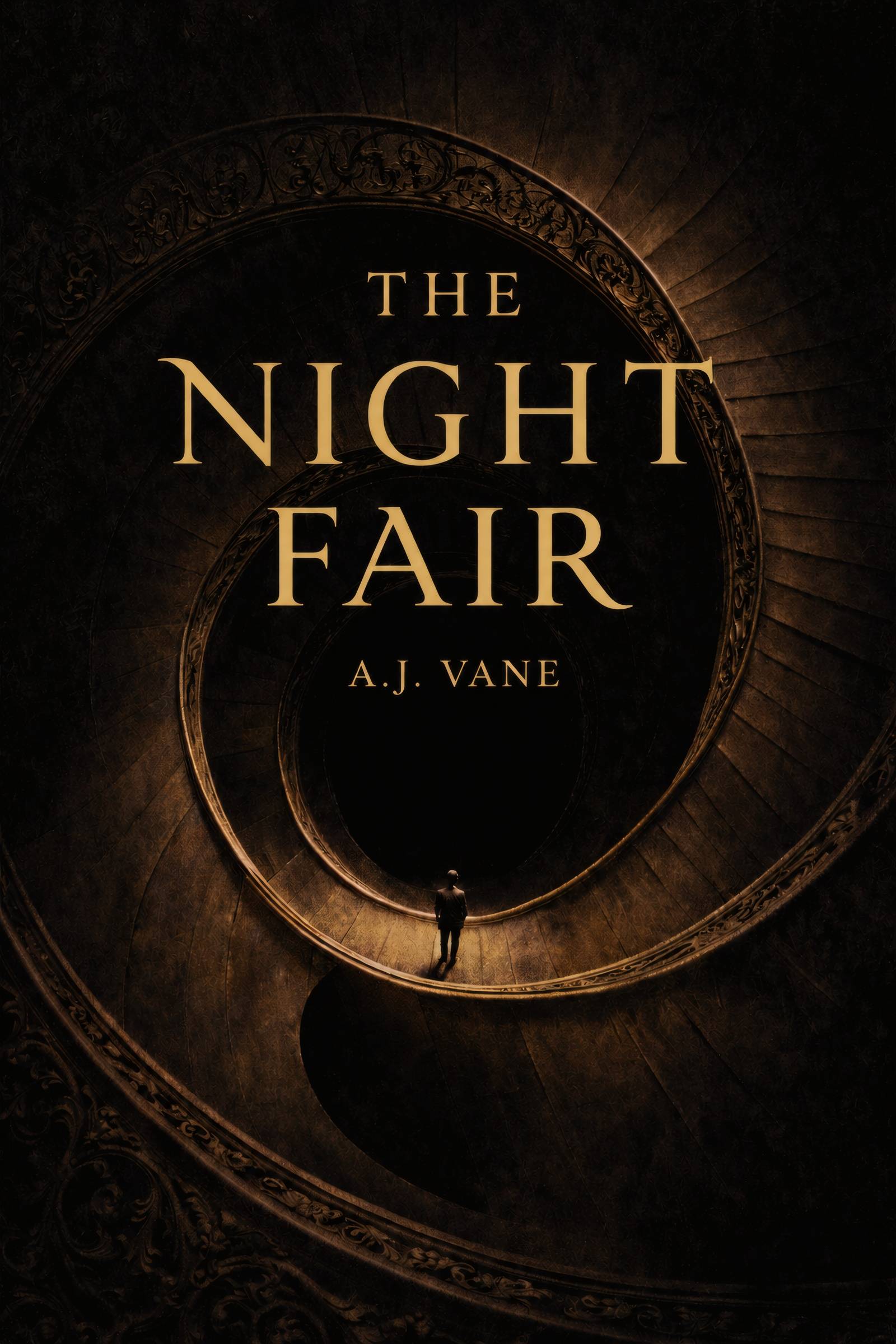
I'll spend an extra line on the cover, because it's a genuinely fine one: a spiral staircase seen from above, gold and sepia sinking into black, one tiny figure alone at the bottom, and a typography where the title rules the frame and stays legible even at thumbnail size — the thing so many indie covers get wrong. It stops the scroll, and whoever designed it understood the book. Kudos, and a little envy.
Under the hood · for the writers reading from home
Let's open it up
By necessity, this part is heavily spoiler-marked. If you write as well as read, come in.
The full teardown — heavy spoilers
The single smartest thing in the novel is how the Fair is built: concentric rings, each inner one dimmer and more devotional than the last, so the reader sinks by degrees without ever being told they're sinking. The structure is the seduction — form and content are the same thing, and it's worth stealing. Also stealable: the way the book closes. The first line and the last are the same question, but the last arrives from a vantage that flips everything, showing you Simon was always near that dark. That's first-class re-readability — something very few authors even attempt.
The flaw, a big one, is the one I already named: the book is really two books. There's a superb one — the opening in the void, the flyer, the phone call, the road, the Pavilion, the dark — and then a long middle section, the costume party, the corridors, the watching paintings, the interviews, where everything is unsettling and nothing happens. Atmosphere is asked to carry too many pages on its own, and on its own it can't; a less patient reader quits right there, just before the best part. It's a structural problem. And the beautiful part is that it fixes itself together with the book's other limit — Lucy.
Yes, Vane, I'm putting my own spin in here — sorry, I can't help myself.
When Malverne lifts Lucy above the crowd, I felt fascination, but I wanted to feel grief, and I didn't, because the novel spends almost all of its interiority inside Simon and only brings Lucy's descent into focus once we already need to love her. Give that middle section a job tied to Lucy, and the soft belly becomes her descent. The pacing problem and the character problem are the same problem, and they share a single solution. We're talking about five or six laser-targeted inserts, two hundred words each. A thousand words more and it's done.
There's also that verbal tic — a constant "or perhaps," "or so he thinks." The first few times it's dread. After a while it starts to sound like the book refusing to commit to its own images. The cure isn't more certainty everywhere; it's trusting the strong image enough to write it and move on. I flag it because I have the opposite tic in my own work, and it comes from the same place: not fully trusting the reader. A memo for me, for Vane, and for every writer listening — readers aren't stupid, we never hold their hand, ever. Let's tattoo it on ourselves, make it our mantra, wake our partner in the dead of night muttering it in our sleep.
Four stars, all earned. Make a few corrections and it becomes a five-star novel — it takes very little. As it stands, it's a debut of the best kind: it makes you trust the writer, it makes you say "okay, this one goes in my favourites and I'll see what else they write." And I have the distinct feeling we'll be hearing about A.J. Vane again — assuming, evidently, that they keep writing.
Vane's horror is a door you walk through. Mine is the room you were born in.
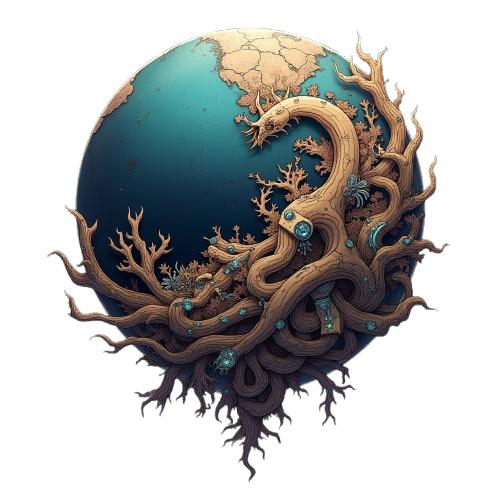
In The Night Fair, the terror lasts one night. In the Motherverse, it's the air you breathe — an ordinary, permanent dark, because the world itself is alive, and you live inside it.
What is Ravenous Mother? →ARC copy received in exchange for an honest review.
Comments