
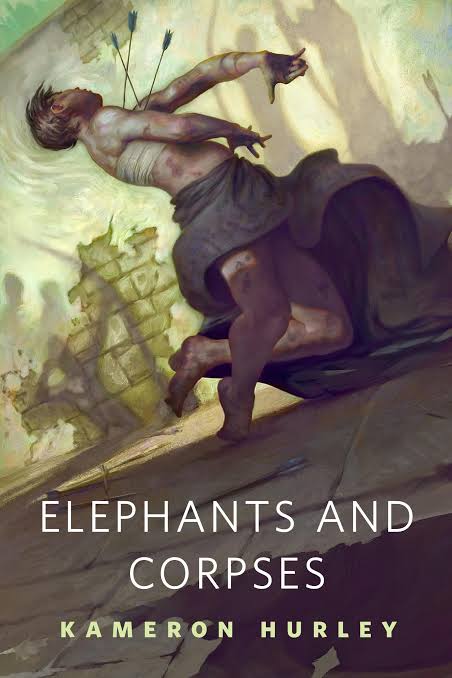
A mercenary who jumps from corpse to corpse and a dwarf elephant.
Kameron, give us a novel!
Nev is a body mercenary. When the body he wears (yes, wears, like in Altered Carbon) dies, his consciousness jumps into another corpse (yes, almost, like Altered Carbon), on one condition: he must have touched it before. The job, therefore, is less about fighting than about maintaining inventory. You buy dead bodies at the docks, process them, and keep them on ice in the basement. A body merc without a stockpile is a dead body merc.
The opening paragraph is a small lesson in how to start a story. Hurley begins with a thesis about other people's bodies (theirs are better than yours), then gets straight to the point. By the fourth line, you already have the premise, protagonist, obsession, and tone.
The city has no name, (I think, I don't remember, and I'm too lazy to get up and check), has a nebula approaching that everyone calls the Eye of God and that the priests swear will eventually swallow them. It has four hundred seven religious sects fighting over followers in the streets, sometimes literally shoving each other around. It has a law stating that men cannot own real estate, which explains why Nev's workshop is registered in his partner's name. And it has viral mages (Hurley likes them, the engineer-mages. They're everywhere in her books) who sell you intelligence in aerosol form, provided you're willing to have your head dunked into something of questionable safety. And straight out of God's War, there are also fireflies the size of thumbs that serve as streetlights at night.
In classic Hurley fashion, none of this is explained. It's the same method she uses in God's War, the same trust in the reader. No hand-holding, ever.
The plot starts when the wrong corpse arrives at the docks: a woman dressed as a man, with a cult tattoo beneath the bandages covering her chest. Tera, Nev's partner, fifty-one years old, former soldier, former janitor, allergic to practically everything, recognizes her sister, who disappeared twenty years earlier. A few hours later, an armed gang smashes through the workshop door, and from there the movie starts rolling.
Personally, I think the story works because of a dwarf elephant named Falid, whom Nev found half-skinned in a ditch ten years earlier and has kept in the yard ever since. Nev claims he doesn't care about people, and after a few hundred bodies, that sounds pretty believable. But he cares about the elephant. Falid has maybe two hundred words of page time in the entire text, and carries the entire third act by himself (I want a dwarf elephant).

There's a sequence about two-thirds of the way through the story, set in a place with no exits and no spare corpses. Hurley stages it with the coldness of a software developer forced to work overtime on a Friday night. It's a disgusting scene and also the best one in the text. I loved it.
The body is inventory: it swells, empties, gets preserved... when you take over a new one, you fill the floor with stuff I won't name, and if you picked the wrong sex, you get to deal with dysphoria that lasts for months.
The villain is cardboard: she shows up, delivers the corruption pitch, collects, end of story. In a text this controlled, that page feels out of place, and the climax solves with the tip of a spear what the rest of the story had set up in a much more compelling way.
Now, for the people obsessed with pointless questions: how biopunk is it?
Less than it looks if you look at the world, more than it looks if you look at the profession.
The material substrate is conventional: sandstone, iron pipes, metal-wrapped doors, scimitars, crossbows... The organic elements, the lamp-like fireflies, viral mages, dwarf elephants, furry chickens, are jewels stitched onto a pseudo-medieval world, not its foundations. And body-jumping is metaphysics with a professional license. There's no science, no laboratory, no genetics. Instead of a corporation, there's a cult.
Body-jumping, though, is infrastructure. Take it away and you've removed everything. Nev's profession is the story. More than the world, biology is what holds the plot together.
Where the story is biopunk to the bone is in the economy. Flesh is a commodity. It's bought at the docks, negotiated over, haggled over. There's a guild with membership dues that kicks you out if you don't pay, and a profession, something like a corpse notary, dedicated to managing the inventory.
Biopunk Verdict
First question: take away the biology. Does the story still stand? No. Without the corpses, Nev makes no sense as a character. Without his profession, there is no story.
Second question: take away the people who own that biology. Does the story still stand? Not that either. We have people buying corpses, a guild collecting dues, and a cult making decisions about them. There is a society behind the story's central idea.
Yep, this is straight-up biopunk!
The story is an excellent starting point for anyone who wants to understand where biopunk window dressing ends and real biopunk begins. Nev's world is varied, purposeful, and built around the plot, while the plot in turn builds the world. It's a solid weave.
Recommended for anyone who loved The Black Company by Glen Cook and wants to see that same soldier-of-fortune voice applied to a world where flesh is inventory. Also recommended, perhaps especially, for anyone who has never read Hurley: half an hour and you'll know immediately whether her dirty grimdark is for you, without committing to an entire novel. The story is free on Reactor, so the cost of entry is exactly zero.
Hurley writes about bodies treated as commodities. I write a universe that is a body.
Take a look at Ravenous Mother!
Comments