

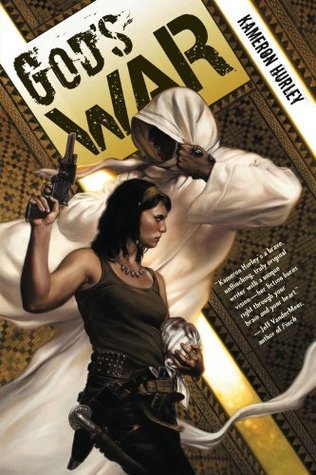
Nyx sold her womb somewhere between Punjai and Faleen, on the edge of the desert.
That's how God's War begins, with a raw, unmistakably Kameronian sentence.
This isn't cheap shock value. Like almost everything in this novel, the sentence serves several purposes: economic (someone buys wombs!), geographical, and technological (at the very least, we know enough to understand that wombs can be removed from people, generally without killing them). Last but not least, in fifteen words, it tells you that the protagonist is either badass enough to sell a part of herself, desperate enough to do it, or both. It's a damn good opening.
Welcome to Umayma! A planet terraformed a thousand years ago and now thoroughly rotten. There is no useful metal, no oil. All technology is biological. Vehicles run on beetles, and when they break down, their tissues blister and blacken. Lamps are fireflies housed in glass, houses are hardened secretions. The magicians don't cast spells: they command insects, and those insects do everything for them (seriously, everything). Normally, with absolutely no shame, I slip references to my own work into my reviews here and there. I don't even have to try with this one. The level of biopunk in this book is stratospheric. Though Kameron, for good reason, prefers to call it bugpunk.
As I was saying, on Umayma, two nations have been fighting a holy war for centuries. They send every man to the front between the ages of sixteen and forty: they either come home at forty or come home in a bag, so women consequently run the governments, trade, and pretty much everything else. Both nations have made their own territories uninhabitable for generations through the use of biological weapons.
The book has no glossary, no prologue, and not a single moment when Kameron stops to say, "Here is what's happening." It's the "jump in the water and swim, bitch" approach, which I share and prefer in genre fiction. I stand corrected. There are explanations, actually, but they gallop alongside the action. Hurley has devised a mechanism, an aside between two dashes inserted directly into an action sentence, that labels what is happening without ever taking her foot off the accelerator. It takes some effort for the first fifty pages, then the reader eventually becomes a resident of Umayma. Personally, I don't love this method (did she really invent it? In my ignorance, I'd never seen it before. If someone knows otherwise, write to me!), but I have to admit that it's extremely effective.
EDIT: I didn't wait for anyone to write in — I went and checked myself. It's called incluing, a term coined by Jo Walton for feeding worldbuilding straight into the narrative flow instead of stopping for it. Hurley didn't invent the technique; it goes back at least to Heinlein and it's more or less standard doctrine in genre SF by now. What's hers is the specific delivery system: the aside jammed between two dashes, fired off mid-action-sentence, at a rate few writers would risk. So: not invented, but sharpened into something meaner than most people's version of it.
Hurley builds her characters through accumulation. She describes gestures until they become a diagnosis. Nyx, whose full name is Nyxnissa, is not likable in the slightest. It's easy to classify her as a "hard-edged protagonist," and that's perfectly fair. Her toughness is concentrated into one clear, defined, monolithic trait: she is completely incapable of giving in. In one scene, reflecting on a man she has just slept with, she admits that the most erotic thing she has ever witnessed was watching him surrender. That thing, surrendering, is something she has never done. She has no idea how to do it, and of course, she knows it. It's an obvious defense mechanism, not disguised in the slightest, screaming TRAUMA from miles away. Nyx is hypervigilant, always alert, always severe.
Around Nyx is a team made entirely of category violations: a foreign mercenary who is a straight man in a society where men are reproductive livestock, a lethal former prisoner with the body of a twelve-year-old, a half-blood kid raised outside the breeding centers, and a devoted foreign magician who is terrible at his job and faints at the sight of his own blood.
Nyx never says she cares about them, nor does she think she does. And yet she keeps hiring them and constantly goes back for them, collecting people who don't belong anywhere. The crew is family, a team of broken people understood as the only form of love, and precisely because it is never spoken aloud, it allows the reader to form an emotional connection with people who, if you met them individually at night, would make you cross the street.
Toward the middle of the book, the pacing slows down. There is a long stretch of buses, trains, and frontier inns where the plot stops moving forward and only the direction remains. The direction is excellent, but in genre fiction, the story has to keep moving. It can't start looking around at itself. At a glance, you could probably cut about one-sixth of the novel without losing a single piece of information.
The book spends two hundred pages promising that the information at the center of the hunt could end the war, and then it doesn't. It's not an oversight: it's the novel's thesis itself. Some wars don't end because too many people have a vested interest in keeping them going, and a different ending would be dishonest to the reader, the novel, and Kameron herself, who is clearly a realist. It's brave, it's honest, but it still leaves you with the feeling that an account has gone unpaid. Some people will like that, some won't. Everyone knows themselves.
God's War was a finalist for the Nebula, Clarke, and BSFA Awards. Its publisher went under shortly afterward! In other words, it's a book loved by awards committees and ignored by the market, and the reason is exactly the same in both cases: it pulls its punches for no one.
This is real biopunk, not just aesthetics. If you've read The Windup Girl by Bacigalupi, some of the same notes will resonate, but God's War is considerably dirtier and far less comforting. If you read Abercrombie and want that same lack of mercy inside a completely different kind of world, or if you're simply tired of protagonists who have to stay likable, this is your book.
Ultimately, I really enjoyed the book, even more than The Stars Are Legion. As I said earlier, Nyx isn't likable. But you understand her, you root for her, and that's what matters most. Kameron knows how to write characters, how to build worlds, how to write action. In a word, she knows how to cook. I've already bought the sequels, Infidel and Rapture, and I'm eager to see where she takes the holy war on Umayma next.
Kameron writes about bodies at the mercy of a hostile universe. I write about universes that are bodies.
Check out Ravenous Mother!
Comments