
Women Giving Birth to Pieces of Spaceship!
Biology, economics, and pragmatism in a single human gesture. It works as a piece of worldbuilding, and it is the last thing you will ever forget about The Stars Are Legion.
Let's start where the book starts. The Legion is a ring of worlds orbiting a sun, and those worlds are organisms. Yes, people live inside enormous, titanic organisms. On my honor: I met Kameron Hurley after I had started writing Ravenous Mother... but I admit the similarities are so enormous that the suspicion is understandable.

Anyway, the Legion. Ship and world are the same word. Corridors pulse. Doors unfold like fleshy flowers. Rain, in the middle levels, is viscous and vaguely salivary, and you're assured that it's good for your gut flora.
These worlds are rotting. The women who inhabit them have been tearing each other apart for generations over the one world that broke away from the orbit and that nobody can conquer: the Mokshi.
I don't remember—and in my immense laziness, I didn't bother looking it up—whether it was Hurley herself or someone else who described this novel in three words: lesbians in space. It's definitely reductive, but it's also a brutal marketing lesson. If it wasn't the author's line, I hope she likes it anyway: the book probably sold well partly because of that tagline.
Our heroine, Zan, wakes up with no memory. She's told that she has led eight hundred and six assaults on the Mokshi, that she's the only one who ever comes out alive, and that she always loses her memories. Jayd, who claims to be her sister, takes care of her, loves her, and manipulates her.
The novel alternates between two first-person present-tense narrators. Zan is betrayed and thrown into the recycling pit, and she has to climb back up through the world's internal levels, gathering allies along the way (put that way, it sounds like a D&D session... and it's not that far off).
Jayd stays behind: she's sold into marriage to the enemy family, and her point of view is an ode to claustrophobia, calculation, and waiting. Movement and stillness alternate in an intelligent structure.
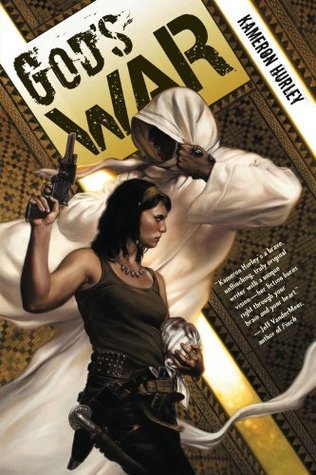
Warning: this is a very much hold-the-reader's-hand-free book, in the best possible way. There is no glossary, no prologue. There isn't a single page where the author stops to explain how the Legion works. If you've read my review of God's War, you already know that this is exactly the kind of respect I appreciate as a reader. Compared with God's War, the technique is pushed even further here. The worldbuilding in The Stars Are Legion is considerably more alien than Umayma's, and it's delivered with the same restraint.
The prose is in the present indicative, first person, lean and sharp. Hurley writes with concrete verbs and physical nouns, and she has an almost arrogant faith in the power of a single bodily image. And damn it, she's right to have it.
Without taking anything away from Zan, the supporting characters are more interesting (and more likable): Das Muni, a mutant rejected by three different worlds, devoted to the point of self-mutilation, who talks about the recycling monsters using names that sound like children's nursery rhymes; Casamir, an engineer from a middle level, who offers Zan an apple—a spongy tuber covered in green eyelashes!!!—and declares with offended dignity that she never jokes about science; Arankadash, a warrior from the lower levels, who has given the world every child she has carried and talks about it the way people talk about the weather (I imagine that by the fifth gear you give birth to, it starts to feel pretty normal).
Let's move on to the flaws. There aren't many, but they're there.
The middle section—the climb through the levels—repeats the same structure three times: Zan reaches a new layer of the world, meets a strong woman, wins her over, and moves on. The D&D party, as I said earlier. It's two hundred pages built around a pattern, and by the third repetition, you feel it.
Worse, in that same section, many passages end up being nothing but worldbuilding: beautiful, but they don't move the plot forward and they don't reveal anything about anyone. By my own standard (I believe a sentence should perform at least two functions, otherwise you cut it mercilessly), those pages don't have enough reasons to exist.
The supporting characters are all functional, and that's the only reason the book avoids falling into filler. But in those pages, you can almost hear Kameron thinking, "One more page and I can get back to the plot." Too bad.
The antagonist doesn't have a single scene that makes her feel like a person. She has motivations to spare, but they're stated aloud rather than dramatized. She has no internal contradictions, no moment when she's anything other than functional. From an author this good with supporting characters, that's a difficult choice to understand. I think—and I'm only speculating—that the reason is that the real enemy isn't her, but the Legion itself. The worldbuilding is fascinating and bleak at the same time, and while Zan carries an incredible history with her, it's clear that every woman on every world in the Legion has plenty to do just to survive. Fine, put that way it's practically a manifesto. But it's not the worldbuilding that keeps Jayd imprisoned for half the book. Characters who have names need to be three-dimensional.
One last thing, and this isn't a criticism: this book contains obstetric violence, forced pregnancy, mutilation, and the use of reproductive biology that is, at times, genuinely difficult to read. None of it is gratuitous—it's the subject of the book—but everyone knows their own limits and what they can handle.
Two Biopunks
The genre has two lineages that the market keeps confusing, and this series of reviews exists to separate them. On one side, there is genetic biopunk—Bacigalupi, Di Filippo, Kress, Greg Bear's Blood Music (assuming we can call it biopunk; plenty of people disagree on that one)—where biotechnology is a living socioeconomic force and the conflict is with whoever controls it.
On the other side, there is organic biopunk—Miéville, Cronenberg, VanderMeer, and this book—where flesh is architecture, the body is environment, and the conflict is with biology itself. The Stars Are Legion is the canonical text of the second axis. A book can belong to only one of the two and still count. It just has to know which one it is.
Spoiler #1 — The Epigraph Mechanism
From here on out, I'm ruining things. If you haven't read the book, skip ahead to the biopunk sections.
Every chapter opens with a quotation attributed to Lord Mokshi, from the Annals of the Legion. There are thirty-nine epigraphs: gnomic pronouncements about power, memory, betrayal, and war. Lord Mokshi can't keep anything inside; they have a visceral need to let you know what they think about... well, everything. Now, this is the most overused fantasy convention in existence. I read them carefully through the third one, then started skimming them absentmindedly.
And then you discover that Lord Mokshi is Zan. Ta-daaaaan! And suddenly you have to go back and read all the epigraphs again!
Yes, it's her, before the amnesia. For thirty-nine chapters, the protagonist has been commenting from outside her own downfall. The meaning of all those sentences changes at once, retroactively. One of the late-chapter epigraphs, where she admits that she loved Jayd despite everything and that she has to let her go, lands after you've already figured it out—and it breaks your legs. It's beautiful. It's poetry.
In other words: Hurley takes a convention and beats it bloody, changes its face, and turns it into something else. I like this author.
Spoiler #2 — Who Betrayed Whom
Full spoilers, including the ending.
The moral of the novel is that there is no victim. It goes further than what we see in George R. R. Martin and Joe Abercrombie. For half the book, Zan is the wronged party: amnesiac, used, thrown away. And she is! Then you discover that Jayd opened the breach in the Mokshi, that Jayd recycled the people of the Mokshi, that Zan knew about it and took her back anyway because she couldn't save her world alone. And you start hating one of them, then the other, understanding them, telling them both to go fuck themselves.
You discover that they were two people who tore each other apart and kept working together because the plan was bigger than either of them, and that they loved each other even while they were doing it. The book doesn't resolve this contradiction. More precisely, it's not a contradiction at all. It's love.
In the control room, at the end, Zan has two options in front of her: reclaim all her memories and become Lord Mokshi again, the woman willing to sacrifice children, womb, and identity to escape the Legion; or reset herself and start over. She's already done it dozens of times. There are recordings of all the previous Zans, talking to one another across the cycles. Zan realizes it's a false choice and chooses a third thing: the woman she has become during the climb.
The ending rejects triumph. The Mokshi is reborn, the Legion remains doomed, and the two protagonists—who have just won—decide not to be together, because what they did to each other can't be undone. It's an ending that respects the damage.
Is The Stars Are Legion biopunk? Yes. That's an unavoidable fact, even though the author has never defined it that way. But the interesting answer is: yes, asymmetrically.
Aesthetically, it screams biopunk at the highest imaginable volume. The replacement of the mechanical with the organic is total.
Women giving birth to pieces of the world—gears, tentacles, weapons, and occasionally a child—is B I O P U N K in all caps and Roman type. The female body is the assembly line.
Fertility is the Legion's primary political resource—it is negotiated, seized, surgically transplanted. That's the "punk" part: a power structure built entirely around the biological output of the bodies it exploits. Finally, there is recycling, which is simultaneously an industrial procedure and a threat of death, to the point that the language no longer distinguishes between the two.
Politically, it's only half biopunk.
There is no biotechnology. Nobody, anywhere in the novel, designs anything. The worlds are ancient artifacts whose science has been lost, and the only character with a technical mindset is reverse-engineering a black box. Classic biopunk—the Bacigalupi and Di Filippo kind—requires biotechnology to be a living technology: contested, patented, iterated, with someone making money from it. Here, it's an incomprehensible inheritance. Which makes the book much closer to biological Dying Earth than to biopunk proper.
The power structure isn't techno-economic... it's feudal: there are families, lords, arranged marriages, dowries, dynastic feuds. It's aristocratic grimdark fantasy dressed in flesh. The classic "punk" target is missing, because there is no system to hack.
To be clear: I stand by my opposition to labels as chains. Is the book "under-engineered biologically"? Who the hell cares? It's fucking awesome. In fact, the idea that knowledge lies so far in the past that it has become irretrievably lost gives me chills down my spine.
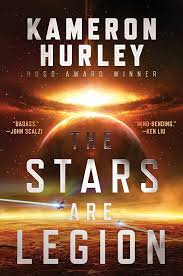
The cover: why? Why? WHY?
The Saga Press cover is technically excellent: impeccable typographic hierarchy, extremely high contrast, readable at postage-stamp size, with the blurbs used as compositional elements instead of simply slapped on top. It's high-level work. Too bad it promises the wrong book.
Are you kidding me? Chrome metal, a red planet, distant explosions, spaceships leaving trails: this cover sells space opera and then delivers Cronenberg. I'm happy that Kameron Hurley has found a level of fame (if only we could all have Hurley's!), but whoever approved this cover should be getting a serious talking-to. It may have cost Hurley hundreds of readers and earned her piles of negative reviews from people who thought they were getting the new Starship Troopers (Miss na kita, Rico! You deserved a second book!).
What a wasted opportunity.
Ultimately, The Stars Are Legion is one of the most original things I've read in science fiction in years. The worldbuilding isn't simply rich; it's new. The biology is functional. It generates the society. I honestly preferred God's War, which is tighter, nastier, and has a protagonist who, let's admit it, is considerably more likable. But the images from this book don't leave you. A woman giving birth to a world is something you remember even on your deathbed.
Recommended—strongly recommended—to anyone who loved Perdido Street Station for its organic invention, Annihilation for its unexplained biological horror, and Gideon the Ninth (I need to find the time to review that one!) for its weird, all-female cast.
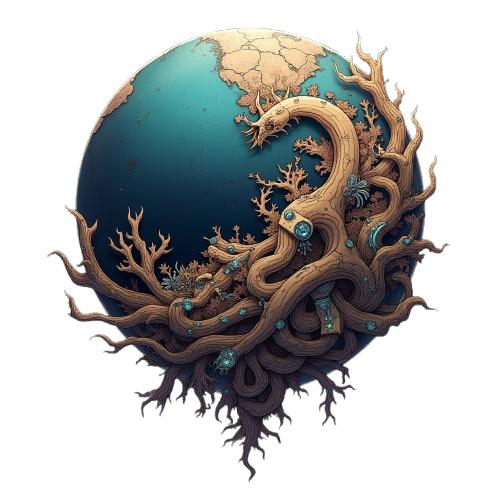
Kameron writes worlds that are bodies. I write a body that is a world, and that world is hungry.
Take a look at Ravenous Mother!
Comments