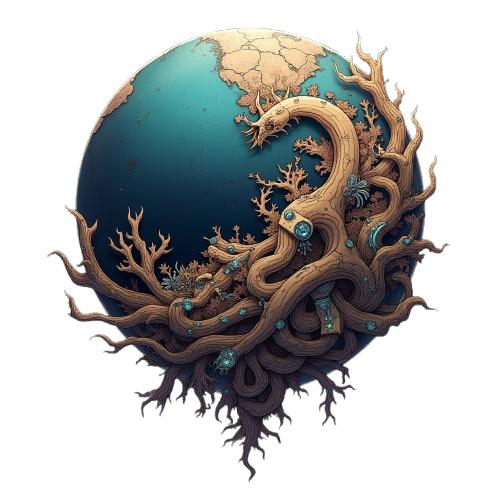

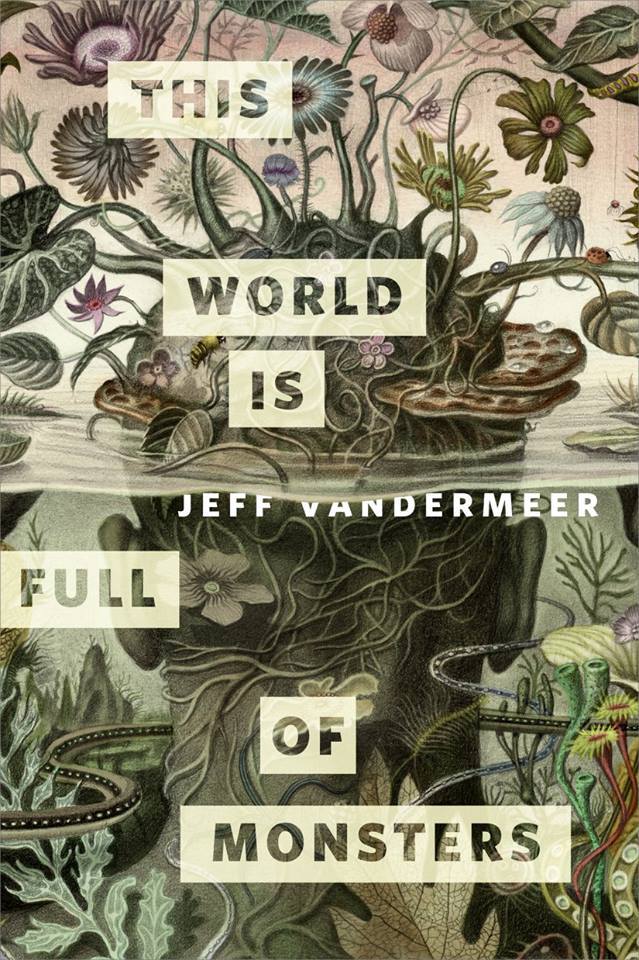
One night, a package shows up on your doorstep. Inside is something that looks like a story.
By the time you realize it isn't one, you've already grown a tree out of your head.
This novelette is a psychedelic trip. The protagonist is a writer, although the text will contradict that later on. He finds an envelope on his doorstep containing a little manuscript that smells like banana bread. He reads it in one sitting, falls asleep on the couch, and the thing he mistook for a story burrows into his stomach and works its way up into his skull. At dawn, he walks to a hill, plants himself face-first into the earth, and stays there for a hundred years.
(Can you taste the acid? Can you hear the Grateful Dead playing in the background?)
When our hero wakes up, humanity is gone. Earth has been rewritten, with a new and unsettling biosphere, and he is the last remnant of the old world, dragging himself through the new one with a withered leg that has become a tail and a cluster of eyes where his eyes used to be.
From there, the story becomes a four-stage pilgrimage, each stage governed by a creature that teaches the protagonist something.
The first creates a brother for him: a double who stayed awake for the entire century, lived in his house, and drank his milk. The brother dies in the basement, dumping a hundred years of stolen memories into him.
The second is a worm as long as the horizon, inside which the protagonist walks for weeks, convinced he's crossing a forest. Only when he reaches the other end does he realize he's been... well, inside an intestine.
The fourth is the ocean (which, OBVIOUSLY, is not an ocean).
I skipped the third one on purpose because it deserves a paragraph of its own. The new creature is called Dead-Shell, and it's the empty shell of a pseudo-turtle. The protagonist empties it out and turns it into a boat; the shell then grows (!) a mouth on its prow and starts talking. This is VanderMeer on a slow Monday morning. Then a thousand eyes grow on Dead-Shell. They live on their own, fly around, perch in the trees along the shore, and get eaten. One by one, every day, something devours one of them, and Dead-Shell feels it. When they're swallowed whole, they keep seeing and reporting back from the stomach of the predator that killed them, sometimes for months.
Dead-Shell is a creature that has lost hundreds of children and knows it will lose more, and meanwhile it ferries a stranger across a lake, explaining why he shouldn't kill himself.
The prose is VanderMeer at the absolute peak of his register: retrospective first person, biological imagery piling up without pause. His syntax works by accumulation: sentences stretch out, linked by conjunctions rather than subordinated clauses, until the reader loses their grip and starts to float. I know that after joking about acid twice, saying it again will sound like another joke, but I'm serious: it's a narrative technique with a genuinely psychedelic effect. I counted roughly: at a glance, about a third of the sentences in the story run longer than thirty words. As someone who writes short, I read this stuff like it's Sanskrit.
It works until you notice what it’s doing. The problem with this effect is that, at a certain point, you can see the trick, and from there on out you get hundred-word paragraphs that could easily have been trimmed. Hypnosis doesn’t always justify verbosity.

There's no need to point out that this story isn't for everyone: there's no conflict, no victory. The colonization is already complete, and there's nothing left to do. Once you understand that, once the reader reaches the same realization as the character, you stop thinking of the story as a progression. It's less narrative than painting.
The four teacher-creatures are wonderful individually, but functionally they all do the same thing: they arrive, transform the protagonist, and leave.
There's one choice in terms of pacing and emotional dosage that I find debatable. The wife and daughter, the emotional heart of the story, remain offstage for the entire thing. They only resurface at the end, after a hundred years of alien strangeness, and what stays with you is the memory of his family. It works. You feel it. But it would have been devastating if that material had been seeded earlier.
This story is classified as biopunk more or less everywhere. It isn't.
Biopunk has two halves, and the name declares both of them. Bio means the technology is biological rather than electronic. VanderMeer has that, in abundance. But punk isn't an aesthetic: it means there is a power structure controlling the biological medium, an economy exploiting it, classes that profit from it or get crushed by it. Gibson isn't cyberpunk because of the neural implants; he's cyberpunk because of the corporations. Take away the corporations and all you're left with is a guy with a cable in his head.
If we apply that rule to this story, we can see that there is no technology: nobody ever engineers or manipulates the biology. There is no agency: the protagonist doesn't change anything, he gets changed, and for ten thousand words the verb is always passive. There is no society to rebel against (there isn't even a society! Humanity ends in the first part of the story!). There is no economy, no rebellion, but above all, there is no critique, and that's the crucial point.
Biopunk is always, underneath it all, a political diagnosis: Bacigalupi talks about calories and patents, Atwood about pharmaceutical corporations, Hurley about war and bodies, I write about hunger and class struggle. Here, biological transformation isn't an oppression to expose: it's a mystical initiation! No biopunk protagonist gets to thank the system that devoured them.
This World Is Full of Monsters is New Weird, not biopunk: close relatives include Annihilation by the same author, Disch's The Genocides, and Ballard's The Drowned World, where the world also transforms and the protagonist, instead of resisting, surrenders to it.
I'm saying this with absolutely no presumption that I've settled the debate, and anyone who disagrees is more than welcome to write to me. But a genre that includes everything doesn't mean anything anymore.
The story is excellent. VanderMeer invents without pause and never hits a wrong note, and the new Earth he builds is unforgettable! Clouds with an upside-down forest hanging from them, boulders that unroll into enormous centipedes... I loved it.
If you liked Annihilation, This World Is Full of Monsters will give you the same feeling, concentrated into two hours. If, on the other hand, you need to know what happens next or need someone to root for, try another bar.
VanderMeer writes a world of ecstasy. I write a world where people work, get sold, and stay alive as long as they're useful.
The Mother is a less pleasant deity, but just as interesting.
Comments