November 2026
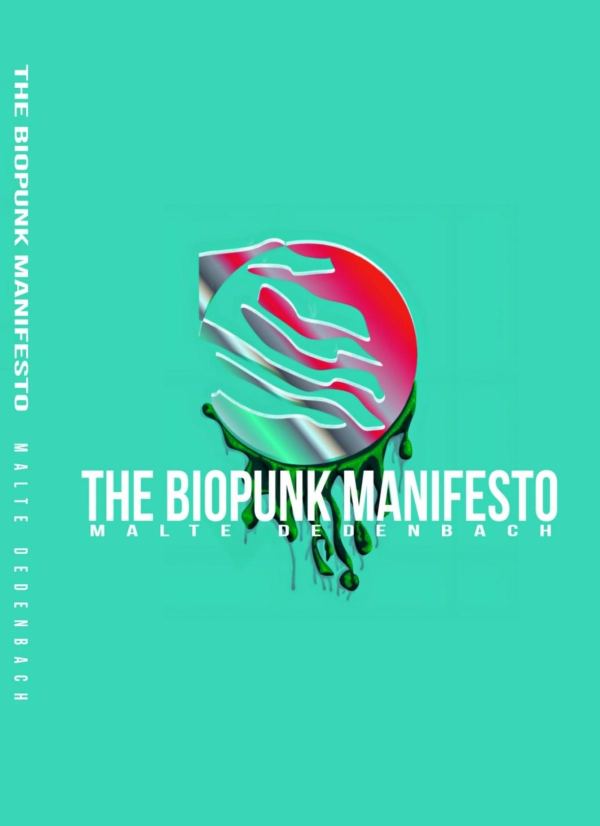
The oceans were colonized by slaves. Then the slaves became the masters.
Let's start with full disclosure. Malte and I met in a thread on r/biopunks about biopunk subgenres, one of those discussions where a handful of nerds argue for two hundred comments over what counts as biopunk and what doesn't. He had posted an excerpt, I looked up the book, and I'd already read a good chunk of it when he wrote to ask me for a review. He later applied to be a beta reader for my next novel, Betrays, and I said yes.
In plain English: we're not buddies who hit the bar together every night after work, but we know each other. If I wrapped up this review with a thundering "MASTERPIECE!", that would be a conflict of interest. But so far I've saved "MASTERPIECE!" for exactly one book, so what follows is what I would have written anyway, flaws included. We're here to build the future of biopunk, not to pat each other on the back.
Let's start with the easy part: the setting ("MASTERPIECE!"). In The Biopunk Manifesto, bioengineering has replaced metal, fuel, and silicon. Houses, vehicles, clothes, and computers are living organisms, and the technology we know belongs to an antediluvian past. The land nations bred posthuman races to colonize the seas (did someone say Rifters by Peter Watts? Yes, I'll get to that later), which is a polite way of saying they bred slaves. The slaves rebelled, won a war of independence, and sealed their borders. Their country is called the United Sea People Polycracy: USPP, an acronym with a vaguely communist ring to it, and I can't tell if that's just me or if Malte did it on purpose. For decades, nobody from the surface has gone down there.
Then, out of the blue, the Polycracy invites a single diplomat: Silvius Creyman, from Gascar, an island of "old humans" that stayed neutral during the war. The book is his travel diary. Or rather, it's a classified government report containing his diary, recovered after... ah, no: no spoilers! I'll just say that the final twist on how the diary makes it back home is a MASTERPIECE moment of pure genius.
Creyman is no ordinary civil servant. He was designed and bred to be a diplomat: his body is packed with hidden organs (sensors, speech analyzers, glands), and a security team back home runs them in real time, whispering advice through a "com cricket" in his ear. Take that, United Nations. The official mission is to reopen relations; the real one is to gather evidence of violations of international genetics law, in other words, to dig up leverage to blackmail the USPP. Creyman leaves Gascar repeating the motto of his diplomatic school: "We must allow ourselves to hope."
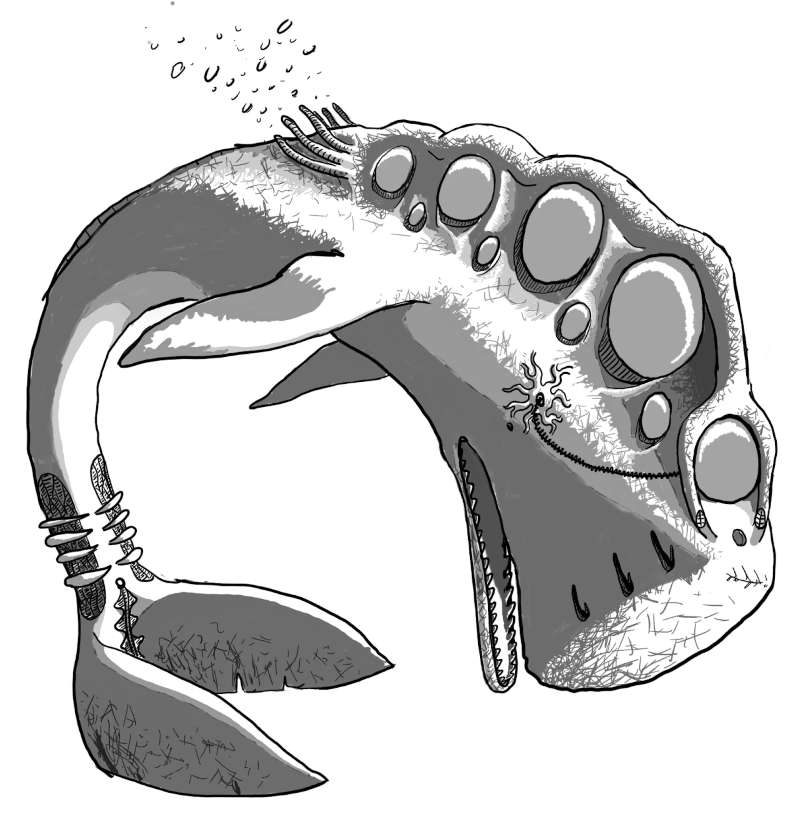
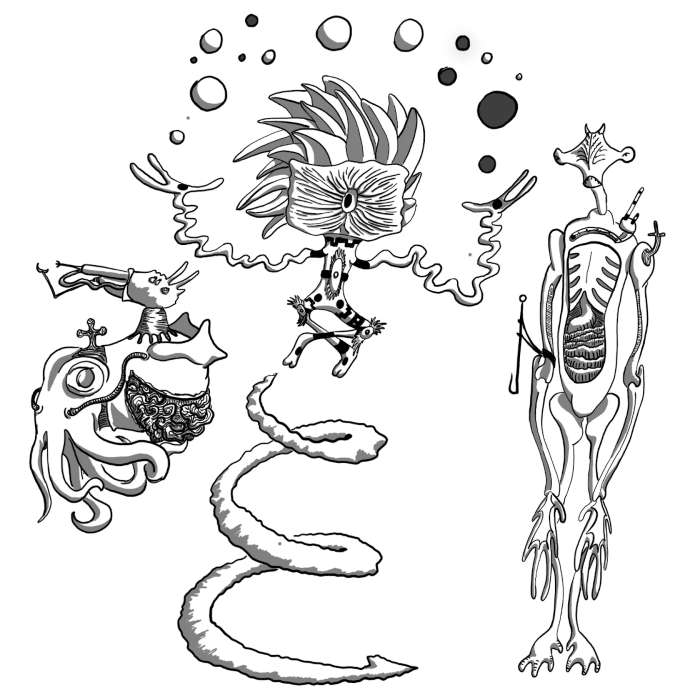
As often happens in biopunk, the real protagonist is the world, and the author builds an extraordinary one, almost suffocating in its variety. Vehicles are domesticated animals. Cities are living membranes braced with steelbone and gigacoral, and Meljupor, the first one Creyman sees, almost looks like a normal old human city, except that its skyscrapers are slowly being submerged into the ocean. They give him a suit that works as a second skin and lets him breathe underwater. On Gascar, even the fog and the rain carry data, thanks to programmed microbes. A noark, a whale-ship, travels between cities as a floating trade center, first class included (Malte drew it, you can see it below: gorgeous!). And at one point, out in the dark, a creature more than a kilometer long glides by with an entire village on its carapace. Organs are inherited, timeshared, and traded on the stock market, like shares in a company you happen to walk around inside.
The Polycracy has no real center of government. There are tribes, councils, and noble families that are also corporations (there's your -punk!), and they fight constantly over anything and everything.
Nobles own dozens of spare bodies and hop from one to the next. "Drones" are people who've been hollowed out and are piloted by someone else; the organs of famous dead people go up for auction; the state religion, ascensionism, preaches engineered ecosystems where every species has a job and none of them compete. It's the ideal everyone quotes and almost nobody lives by.
Long story short, three pages of The Biopunk Manifesto hold more ideas than entire sagas, and the author tosses them out with cheerful nonchalance.
Once he arrives in the USSR USPP, Creyman is greeted by an ambassador who explains their society like a tourist brochure. It's a lovely explanation, but also a heavy infodump. At the top are the first-gens, the closest to old humans: many of the politicians who handle foreign relations are first-gens. Then come the dolphins, a sort of middle class, proud of having founded the nation. Then the crabs, the working class of the abyss, whom the ambassador praises with the fervor of someone who has never actually met one. The jellyfish are the technomancers who shape genes. The "channels," specialists in manipulating crowds, are where the ambassador stalls mid-sentence, as if someone had just yanked his leash. And at the bottom are the squids, the only sapient species that isn't human (and despised for exactly that reason: Karl calls them squid scum): citizens on paper, a lot less so in practice.
So the USPP was born from a people bred as slaves who, once free, chose the shape of their former masters as their ideal of beauty (and, in a not-so-different shape, became masters in turn). They call it the "Olympian standard," and the ambassador proudly presents it as the heritage of their creators. And at the top of the ladder, wouldn't you know it, sit precisely the ones who look most like old humans.
To tell biopunk apart from just any dystopia, I usually ask two questions (you'll find the test in my article on biopunk). Take away the biology: is there still a story? Take away who owns the biology: is there still a story? The Biopunk Manifesto screams no to both. Slaves bred to spec, bloodlines as property, organs on the market, genes on the black market: it's the most biopunk book I've reviewed so far, and Malte picked the right title. On my ownership scale it sits squarely on the second rung, where flesh is intellectual property and somebody holds the patent.
The structure of the book-as-diary is interesting. The government office's notes, in italics, keep interrupting it. They censor it, second-guess it, and scold Creyman for having opinions ("No judgement of USPP characters shall be allowed in the official records"). It's obvious nobody back home trusts him, and they read his diary with suspicion. At some point the notes stop, and the last one orders everything that follows to be kept from the public. From there on, you're reading a top-secret document.
About the ending, I'm as mute as a mutant fish. I'll just say the trail of clues leads to a satisfying payoff.
Inside the diary there are other diaries: the log of a corporate cop with no private thoughts, and the delirium of Genji, a man being turned into a drone who keeps repeating that he needs to know what time it is.
Gabriel is a replicant soldier from the war of independence, 31st regiment, the "angels." Every death means Gabriel's mind gets copied into a new body, each one more monstrous than the last. Gabriel has opinions on the matter, none of them printable without slapping an adults-only label on this review. These pages are foul-mouthed and furious, and together they make up almost a fifth of the novel. Every time the book cuts to Gabriel, it wakes up. The best action sequences are all Gabriel's. If Malte ever writes a spin-off, it should be about this tragic character.
An honorable mention goes to Øpistor, my favorite character. They get a single scene, about two thirds of the way through the book: a jellyfish fused to a lobster's carapace, with a cascade of tanks and propulsion units where the legs should be and about fifty eyestalks where the face should be (yes, I know, one read isn't enough. Go back to the start of the line and read it again.). Øpistor introduces themselves as the gene godfather, the most wanted genestealer in the nation, and there's an underground stock market where people bet on which genome they'll steal next. Øpistor apologizes for sometimes talking scrambled: a faked geneline, spread on purpose to sabotage them, once left them almost mute. I loved this detail, because small things show how a society works better than a page of infodump. If genelines have value, fakes exist; if fakes exist, poisoned fakes exist, made to hit the thieves; and whoever lives off that market carries the scars in their own body. I wish the rest of the book showed this kind of care for its characters more often.
Øpistor is also the first character to tell Creyman to his face that Gascar isn't as clean as it looks, and that the island quietly scrubbed its own gene pool. Creyman answers with the official version he learned in school, and the question rightly stays unresolved.
Øpistor reminded me of Gibbons, the geneticist in Bacigalupi's The Windup Girl who hacks the corporations' patented seeds. The difference between the two is telling. I don't know if Malte drew any inspiration from him.
Now for the flip side: the book is slow.
Before anything irreversible happens, you get about a quarter of the book in guided tours, a history essay, and explanations from guides, diplomats, and assorted characters. Everyone explains, Creyman listens and takes notes, then everyone explains again. A biopunk fan will probably enjoy it, and I did enjoy it, but in all intellectual honesty I have to admit it made me wrinkle my nose. The prose leans too hard on infodump, and in some ways the book risks being a "bad sample" of biopunk: to a newcomer, say a homemaker in Blackfoot, Idaho, who has never heard of Kameron Hurley or Peter Watts, it might give the wrong impression that biopunk is boring, or too complicated, or both at once.
In the end, it's a book for genre fans that shuts the door on anyone who just wants to peek inside. Nothing wrong with that: every book speaks to its own audience, and Malte doesn't sell it as generic sci-fi or mainstream fiction. He says it loud and clear, starting with the title: it's about biopunk, it's a manifesto. Taken for what it is, it's an honest read. I'm still a little sad about it: picked up again and fixed in a few places (and cut ruthlessly in many others. I'll say it again, there's enough material here for a ten-book saga), it could become a stunning thriller.
Back to the characters: Creyman doesn't want anything in particular until the diplomat stops being a guest and becomes a hostage, and even then he works more like a camera than a person. Malte seems to know it: in a chart of his characters ranked by madness, which he posted on r/biopunks, Creyman sits in the lowest tier, his madness secondhand, borrowed from the people around him. That's exactly his function, and exactly his limit. Once he's a hostage, the novel partly shifts gears. And when Gabriel shows up, it really gets moving, if only for a while.
About the English: you can tell from the first pages that it isn't Malte's first language. There are unusual turns of phrase and punctuation habits that come from somewhere else (German and English quotation marks, sometimes on the same page). That's not entirely a bad thing, quite the opposite! It gives the book a certain exotic flavor, and given how far into the future it's set, I personally consider it a tasty glitch.
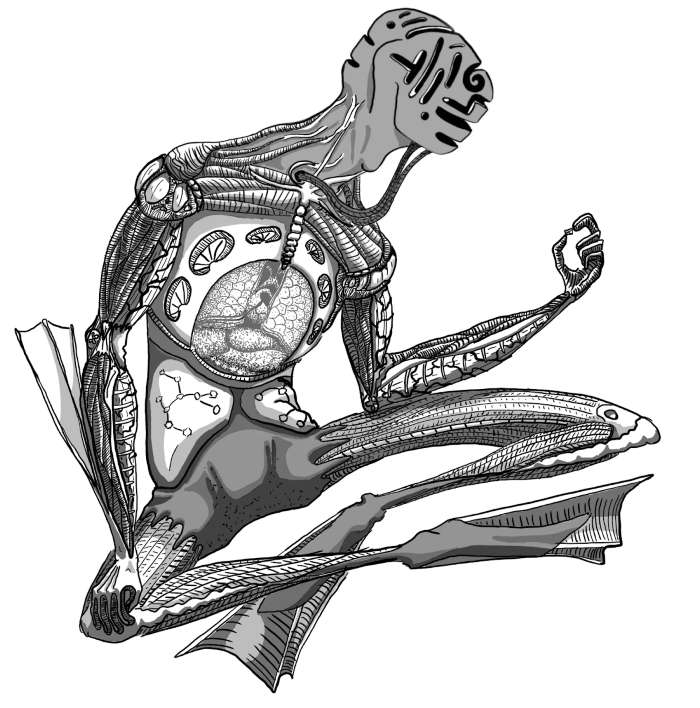
The book includes eight of his ink plates, among them anatomical drawings of posthuman bodies with their organs exposed, and they're honestly gorgeous. The colophon says "Made by humans," and it shows.
Content warnings: graphic violence and body horror everywhere, cannibalism, slavery and mind control, sexual exploitation of hollowed-out people, and very explicit sexual language in Gabriel's sections. Not a book for Sunday school.
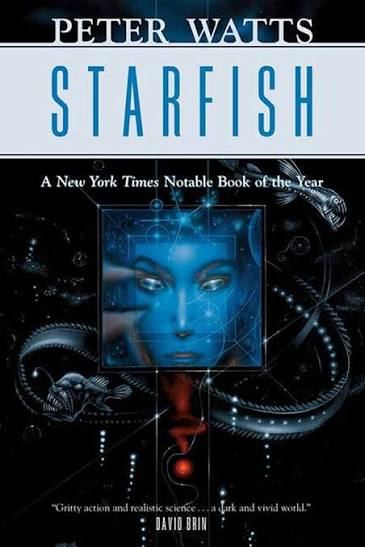
A quick detour: in his Rifters trilogy (Starfish, Maelstrom, βehemoth), an energy company modifies human beings to live on the seafloor, and for the job it picks troubled people, because supposedly they handle the dark and the pressure better (a highly debatable theory, if you ask me). They're few and expendable, locked in a station at the bottom of the ocean. The Biopunk Manifesto reads almost like what might happen generations later, once the people modified for the abyss have become a nation, won a war, and stopped asking the surface for permission. It isn't a real sequel, and I don't know if Malte ever thought of it that way, but if you've read Watts and wondered where the rifters would end up a hundred years later, this is one possible answer: less technical, less bleak, and a lot chattier. Also, Watts, a big supporter of copyleft (and why wouldn't he be, it made his fortune!), put Starfish and other books online for free, under a Creative Commons license, on his website.
READ IT.
So who is The Biopunk Manifesto for?
Insiders, first of all. But also fans of "weird stuff." Anyone who read and loved Miéville's The Scar, and readers of Greg Bear (Blood Music, though explaining why would be a vicious spoiler). Anyone who's read Annihilation will recognize the expedition report as a form, with one difference: VanderMeer never explains anything, and Malte explains everything.
If you come from video games, think BioShock: an underwater city born from a utopia gone bad, ruled by genetically modified aristocrats who love the sound of their own voice. I'm going from memory here (it's the end of the article and I'm getting lazy, don't lynch me if I'm wrong), but I think Watts wrote for or consulted on BioShock.
Edit: I checked, and no, BioShock has nothing to do with it. Watts wrote Crysis: Legion, the novel based on Crysis 2.
I'm giving the book four stars, and I'll be honest about why it gets the fourth: ambition. I have a visceral love for brave authors, the ones who don't settle for the mainstream, the already-seen, whatever's proven to work. They are (we are?) the pioneers of what's coming, the ones leading the wagons toward new literary frontiers. Malte built an entire political economy of flesh, and he had the guts to actually use it. With a native-speaker editor and a leaner first act, it would be a different book. Put duct tape over the characters' mouths, skip the monologues and the elegies, and out would come a "MASTERPIECE!".
If a sequel comes out, I'll read it.
In the meantime, if you want to see biopunk used as a form of government, put it on the shelf next to Hurley. And if the world grabs you, the author runs a wiki that's also one of the most serious attempts I've seen to map biopunk as a whole, seven subgenres included.
Malte writes about a world where every body has an owner. I write about a world that is the owner.
Ravenous Mother: Betrays
Humanity lives inside the Mother. Its rulers decide who she eats. Thandie is a cartographer, not a hero: betrayed by her only ally, she flees into the sewers as a nameless heretic, and to protect the outcasts who become her family, she has to learn to betray.
Discover BetraysNew to the Mother? What is Ravenous Mother? · What is Biopunk?
You Might Also Like
Biopunk where somebody owns the flesh, and wants you to know it. More from the same shelf below.
 Review
God's War
A badly terraformed planet, a holy war, and tons of insects. And Kameron, the queen of biopunk.
 Article
10 Essential Biopunk Works
The ten books that built biopunk: Moreau, Lilith's Brood, Ribofunk, Perdido Street Station, Oryx and Crake, The Windup Girl, Leviathan, God's War, Annihilation, The Stars Are Legion.
Comments